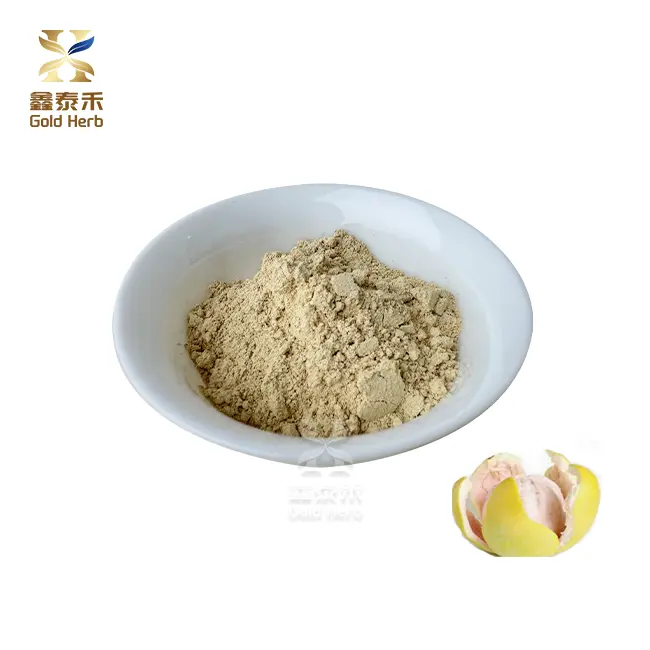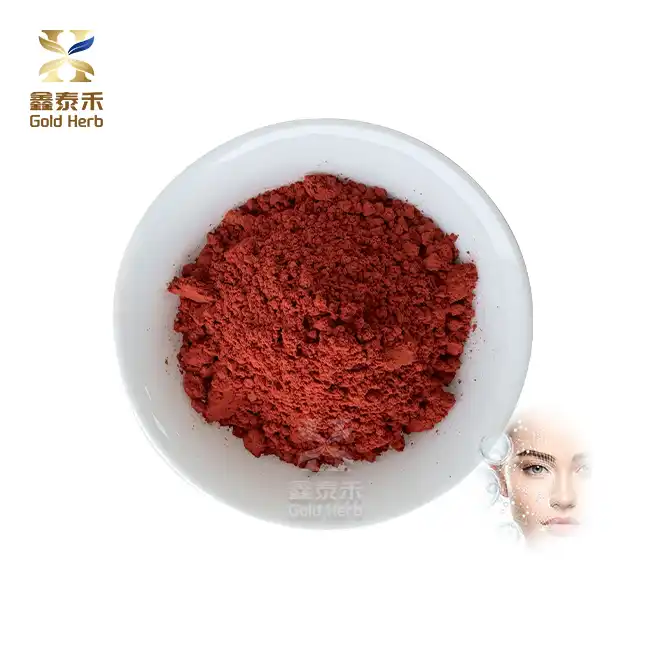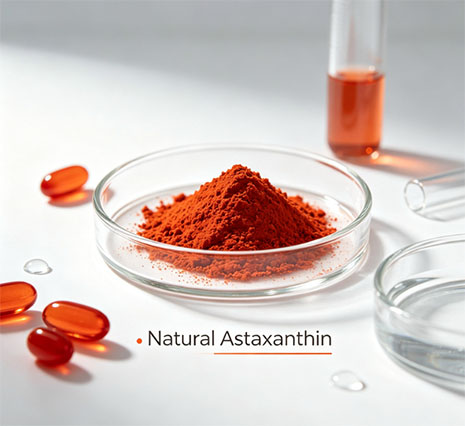
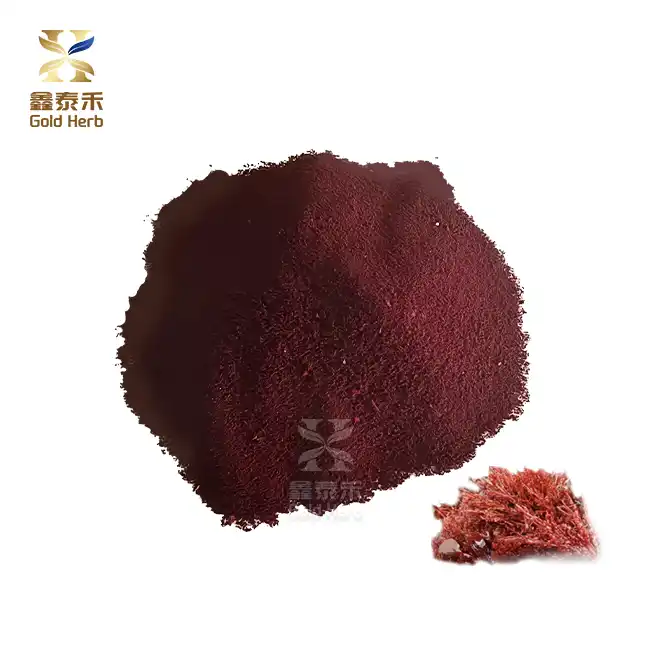
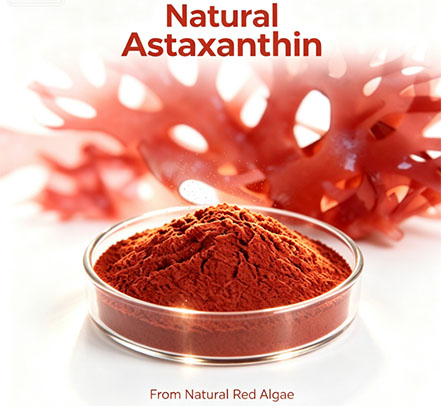
Natural Astaxanthin Powder
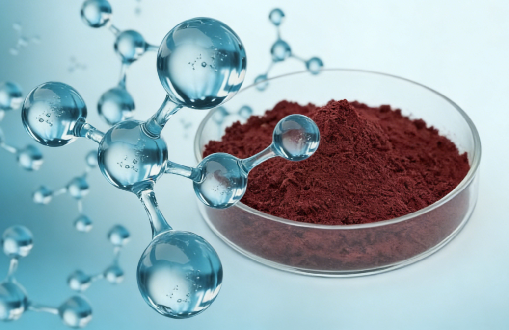
Appearance: Dark red to brown crystalline powder
Specification:1%,2%,3%,5%,10%
CAS No: 472-61-7
Test Method:HPLC
Sample: Provided
Customized service:Available
Storage: Store in tightly closed original container, protected from light
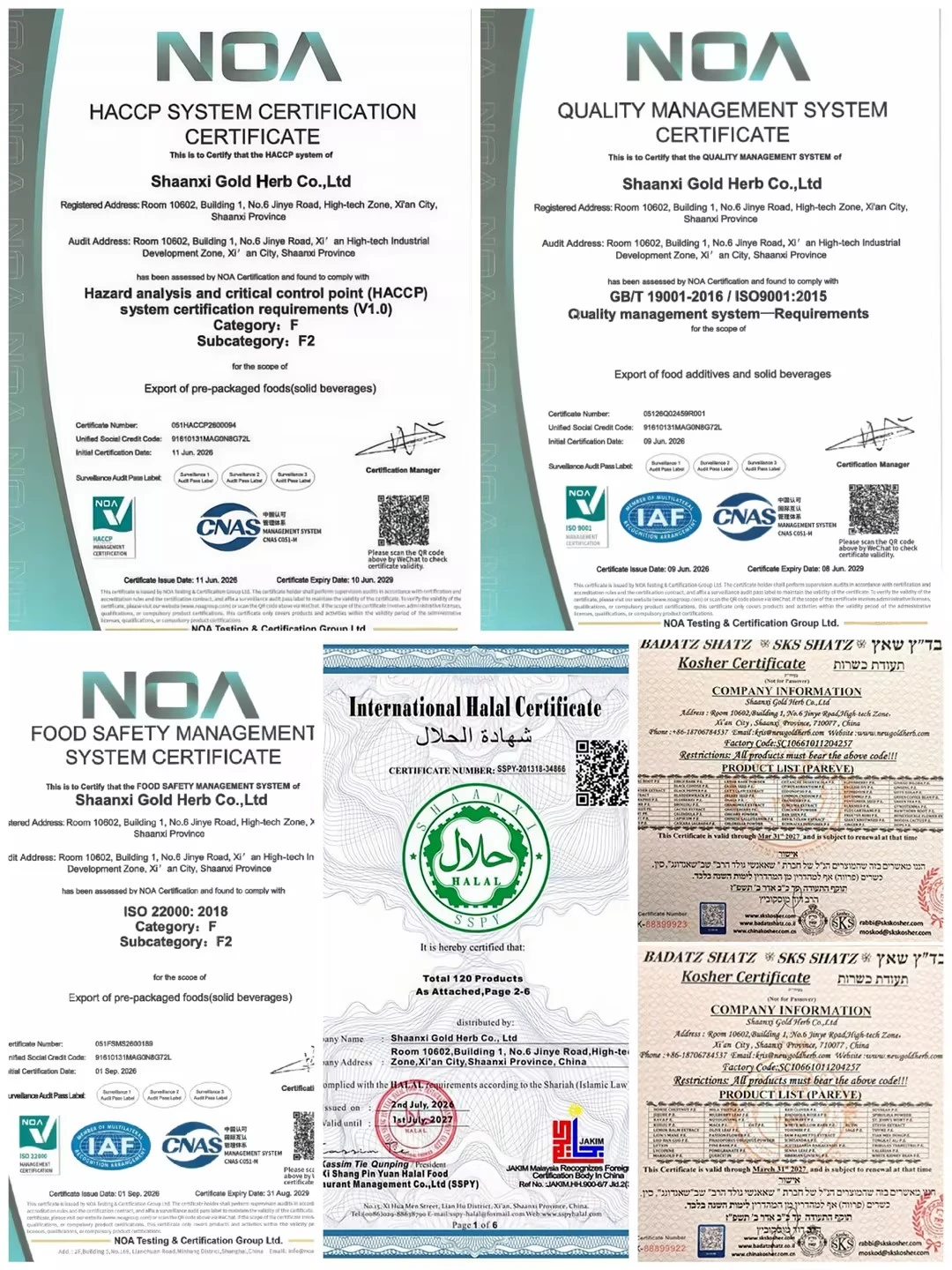
Certificate:FDA, ISO9001, HACCP, HALAL, Kosher

- Free Samples
- Quality Assurance
- 24/7 Customer Service
Product Introduction
Natural Astaxanthin Powder from Haematococcus pluvialis
Natural astaxanthin powder derived from Haematococcus pluvialis, available in 1%, 2%, 3%, 5%, and 10% concentrations. The ingredient is intended for manufacturers and formulation teams working with dietary supplements, functional foods, beverages, cosmetics, and personal care products.
Gold Herb provides samples, product specifications, and applicable technical documents for ingredient evaluation and commercial purchasing.
Request COA | Request Sample | Get Bulk Quot
Product Specifications
| Parameter | Details |
|---|---|
| Product Name | Natural Astaxanthin Powder |
| Appearance | Dark red to brown crystalline powder |
| Specification | 1%, 2%, 3%, 5%, 10% |
| CAS No | 472-61-7 |
| Molecular Formula | C40H52O4 |
| Molecular Weight | 596.84 |
| Test Method | HPLC |
| Solubility | Insoluble in water, soluble in organic solvents |
| Sample | Provided |
| Customized Service | Available |
| Storage | Store in tightly closed original container, protected from light |
| Certificates | FDA, ISO9001, HACCP, HALAL, Kosher |
Quality Assurance
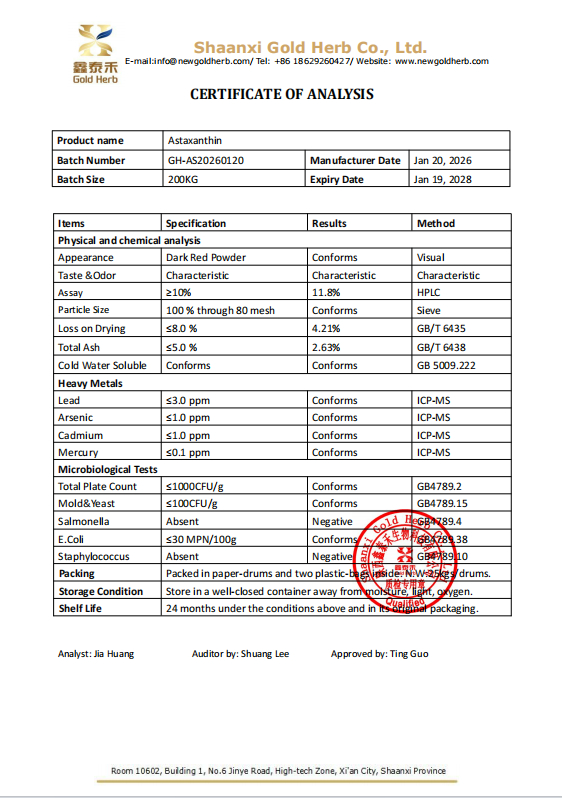
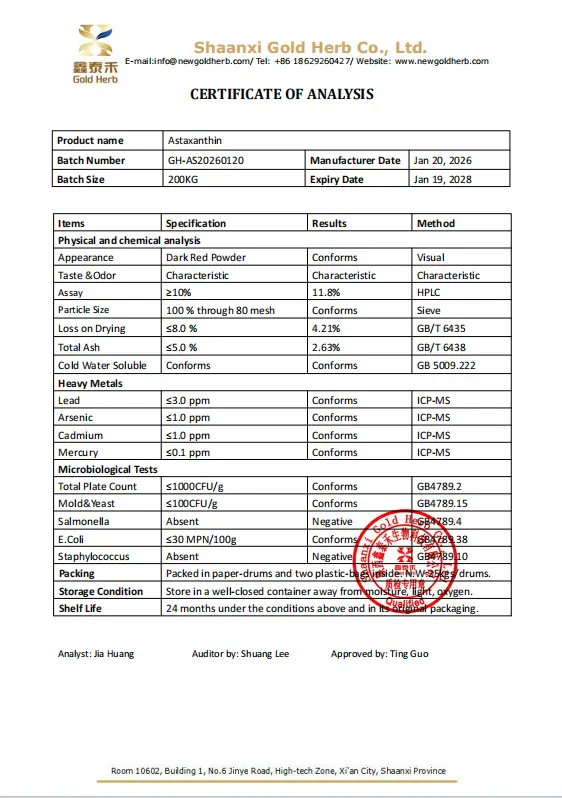
Certificate of Analysis (COA) for Astaxanthin Powder[Request COA]
Haematococcus pluvialis Astaxanthin Source
Haematococcus pluvialis is a microalgal source used for naturally derived astaxanthin production.
The source is an important qualification point because the term “astaxanthin” alone does not identify whether a material is naturally derived or synthetic. For formulation projects where natural origin matters, the botanical or biological source should be stated clearly in the product specification and supporting documentation.
Following cultivation and harvesting, the biomass undergoes downstream processing to recover and concentrate the target carotenoid. The resulting ingredient is then standardized according to its declared astaxanthin content.
When comparing materials, technical teams can review source, assay, analytical method, appearance, storage requirements, and batch information together.
Astaxanthin Concentration Options
Gold Herb offers several concentration levels for different formulation requirements:
| Concentration | Procurement Focus |
|---|---|
| 1% | Lower-concentration formulations |
| 2% | Intermediate-strength formulations |
| 3% | Concentrated ingredient programs |
| 5% | Higher-strength formulations |
| 10% | High-concentration raw material requirements |
The appropriate level depends on the finished formulation, dosage target, processing conditions, and required ingredient format.
For quotation purposes, specifying the desired concentration at the beginning helps avoid unnecessary back-and-forth during product evaluation.
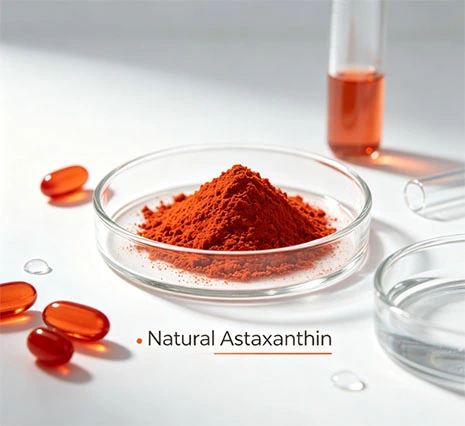
Natural Astaxanthin Bulk Raw Material
For bulk raw material purchasing, the commercial specification should be established before discussing quantity alone.
A typical inquiry includes:
- Required astaxanthin concentration
- Estimated quantity
- Intended product category
- Destination market
- Packaging requirement
- Required analytical documents
- Sample requirement
A sample can be evaluated before a larger purchase to confirm the material against the agreed technical requirements.
For repeat orders, keeping the same product specification and documentation requirements can also make subsequent purchasing more consistent.
Applications
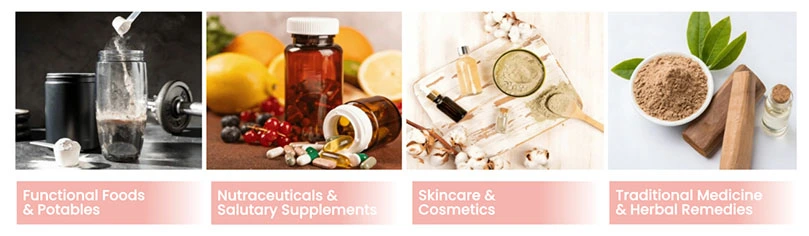
The ingredient is used across several formulation categories.
Dietary Supplements
Applications may include capsules, tablets, powders, softgels, and other supplement formats.
Functional Foods and Beverages
It can be evaluated for food and beverage formulations requiring a naturally derived carotenoid ingredient.
Cosmetics and Personal Care
The material is also used in selected cosmetic and personal-care formulations where astaxanthin is part of the ingredient specification.
Final use depends on formulation design, applicable regulations, dosage, processing conditions, and market requirements.
Natural vs Synthetic Astaxanthin
The source and production route are key differences between natural and synthetic material.
| Factor | Natural Astaxanthin | Synthetic Astaxanthin |
|---|---|---|
| Source | Natural biological source such as Haematococcus pluvialis | Chemical synthesis |
| Origin | Naturally derived | Synthetic |
| Supplier documentation | Source and production information are relevant | Chemical specification and production information are relevant |
| Purchasing consideration | Source, concentration, assay, and batch records | Composition, purity, assay, and batch records |
For natural-origin formulations, confirming the source is part of normal raw-material qualification.
How to Evaluate a Natural Astaxanthin Supplier
When comparing a natural astaxanthin supplier, five areas deserve particular attention.
1. Source
Confirm that the stated source is Haematococcus pluvialis and that it matches the required product specification.
2. Assay
Check the declared concentration and analytical method, rather than comparing percentages without considering how they were measured.
3. Batch Information
Review a representative COA and the parameters relevant to your formulation.
4. Sample Evaluation
Where appropriate, compare the sample with your internal requirements before moving to commercial quantities.
5. Supply Capability
Confirm available concentrations, documentation, packaging, quantity, and commercial terms.
This provides a more useful basis for supplier comparison than relying on a single headline specification.
Natural Astaxanthin Manufacturer and Supply Information
For buyers looking for a natural astaxanthin manufacturer, the evaluation should cover both the ingredient and the production system behind it.
Relevant points include:
- Defined source and concentration
- Production and processing controls
- Laboratory testing
- Batch release procedures
- Traceability
- Technical documentation
- Sample evaluation
- Commercial supply arrangements
Gold Herb's approach is based on a defined product specification, allowing formulation and purchasing teams to review the material from initial sample through commercial supply.
Packaging and Ordering
Packaging should be confirmed according to the selected concentration, order quantity, and project requirements.
The purchasing process can be kept straightforward:
Define Requirement → Review Specification → Request Sample → Evaluate Material → Confirm Commercial Order
When requesting a quotation, include the concentration, estimated quantity, application, destination, and any documentation requirements.

Why Gold Herb
Gold Herb focuses on specification-based ingredient supply rather than treating natural astaxanthin as a generic algae powder.
The available concentration range provides several options for formulation development, while samples and technical documentation can be used during qualification.
Quality control may include incoming material inspection, process-stage checks, laboratory analysis, final release, and batch traceability according to the applicable production system.
This gives purchasing and formulation teams a clearer framework for evaluating the ingredient before moving from sample quantities to commercial orders.
Related Anti-Aging Ingredients
For projects building a broader anti-aging ingredient portfolio, related materials include:
- Urolithin A Powder
- Ergothioneine Powder
- NMN Pure Powder
- PQQ Powder
- Spermidine Powder
- Fisetin Powder
- CoQ10 Powder
Each ingredient should be evaluated according to its own source, active content, analytical method, and intended use.
Frequently Asked Questions
What is natural astaxanthin powder?
It is a powdered ingredient containing naturally derived astaxanthin. The material described here is derived from Haematococcus pluvialis and is available in several standardized concentrations.
What is Haematococcus pluvialis?
Haematococcus pluvialis is a microalgal source associated with natural astaxanthin production. Its biomass is processed to recover and concentrate astaxanthin.
What concentrations are available?
Available concentrations are 1%, 2%, 3%, 5%, and 10%.
Can I purchase natural astaxanthin in bulk?
Yes. Commercial quantities can be discussed according to the selected concentration, quantity, packaging, destination, and documentation requirements.
Can I request a sample?
Yes. Samples are available for ingredient evaluation.
How is the astaxanthin content tested?
The declared astaxanthin content is tested using HPLC according to the applicable product specification.
What documents can be provided?
Depending on the product and order, documents may include a COA, TDS, MSDS/SDS, product specification, and applicable batch records.
Is this astaxanthin naturally derived?
Yes. The material is derived from Haematococcus pluvialis, a natural microalgal source.
What are the main applications?
The ingredient can be evaluated for dietary supplements, functional foods, beverages, cosmetics, and personal-care formulations.
How should the material be stored?
Keep the product tightly closed and protected from light. Follow the applicable product specification for detailed storage requirements.
What information is needed for a quotation?
Provide the required concentration, estimated quantity, application, destination, packaging preference, and documentation requirements.
Request Natural Astaxanthin Powder
For Haematococcus pluvialis astaxanthin intended for formulation or commercial ingredient sourcing, send your required concentration, quantity, application, and destination.
Email: info@newgoldherb.com
Send Inquiry