
Berberine HCL 97%: More Effective Than Regular Berberine?
Jul 14, 2026
When product makers and purchasing managers look at plant extracts, the purity level is often what determines how well the formulation works. Berberine HCL 97% is a standardised, high-purity quaternary ammonium alkaloid that fixes problems with variability that come up with lower-quality extracts. This high-quality substance, which comes from either Coptis chinensis or Berberis aristata, consistently activates AMPK and helps the breakdown of glucose. Generic berberine powders range in purity from 50 to 85%. The 97% standard guarantees accurate doses, less excipient volume in pills, and consistent performance from batch to batch. For brands that are trying to reach people who are interested in metabolic health, this purity level means that their label claims will be stronger and their products will stand out more.
If you're looking for a trusted Berberine HCl Powder Supplier, Gold Herb offers premium-quality Berberine Hydrochloride (Berberine HCl) for the global nutraceutical, pharmaceutical, food, and dietary supplement industries. Manufactured under stringent quality control standards, every batch is supported by a comprehensive COA (Certificate of Analysis), Laboratory Reports, and detailed product specifications to ensure high purity, potency, and batch-to-batch consistency. We also provide Samples for evaluation before bulk purchasing, enabling you to verify product quality and performance with confidence. Whether you require bulk supply, customized packaging, or OEM/ODM solutions, our experienced Technical Support team is ready to assist with product selection, regulatory documentation, and sourcing requirements. Contact us at info@newgoldherb.com to request a quotation, quality documents, or samples, and discover why Gold Herb is a trusted global supplier of premium Berberine HCl for metabolic health, dietary supplement, and functional nutrition formulations.

Introduction
Berberine, one of the most researched plant alkaloids in nutraceuticals, is in demand worldwide by B2B clients seeking evidence-based metabolic health solutions. The buying departments of supplement brands, functional food producers, and cosmetic formulators realize that ingredient purity affects product performance and regulatory compliance. The market wants clear labeling and constant bioactive performance, thus botanical actives are becoming more pure.
Why buying professionals should use Berberine HCL 97% is explained in this tutorial. We discuss its chemical benefits over other berberines, compare it to metformin, and provide helpful locating tips. Formulation specialists will understand dosage limitations and compatibility insights. We'll discuss how this high-grade substance handles industrial difficulties, including stability, quality control, and worldwide compliance. Knowing these distinctions can assist your sports nutrition formulas or medical-grade supplements operate better and grow your business.
Product Specifications
| Parameter | Specification |
|---|---|
| Product Name | 97% Berberine HCL Powder |
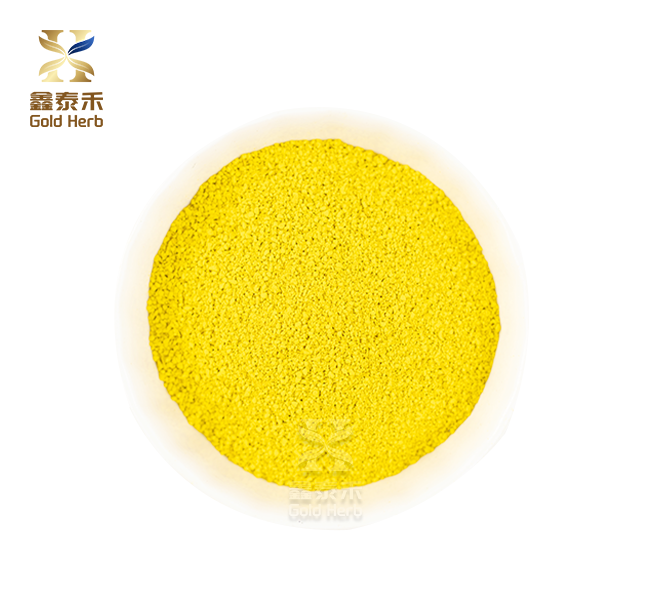
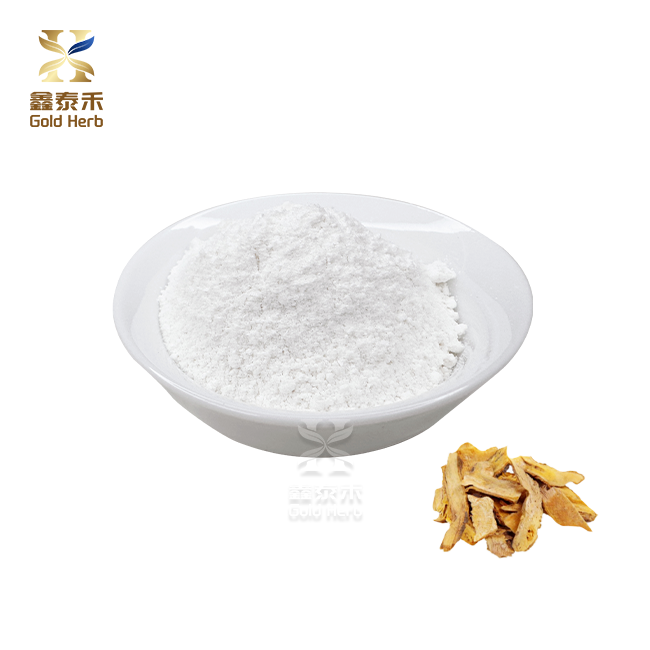
| Appearance | Yellow Powder |
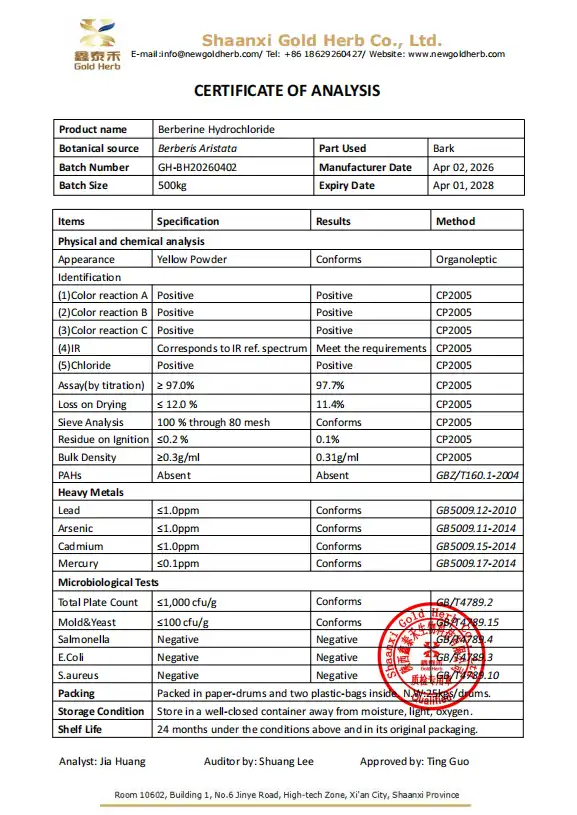
| Assay | ≥97% Berberine HCl |
| CAS Number | 633-65-8 |
| Formula | C20H18ClNO4·2H2O |
| Molecular Weight | 407.85 |
| Test Method | HPLC, UV |
| Loss on Drying | ≤12.0% |
| Residue on Ignition | ≤0.2% |
| Particle Size | 100% pass 80 mesh |
| Solubility | Soluble in water and ethanol |
| Storage | Store in tightly closed container, protected from light |
| Certifications | FDA, ISO9001, HACCP, HALAL, Kosher |
Quality Assurance
Certificate of Analysis (COA) Berberine HCL Powder [Request COA]
Understanding Berberine HCL 97% and Its BenefitsWhat Defines High-Purity Berberine Hydrochloride?
Berberine HCL 97% is HPLC-standardized berberine hydrochloride at 97%. These yellow crystalline powders (CAS 633-65-8) differ from plant extracts and less pure powders. The hydrochloride salt dissolves better in water than berberine sulphate, although both require particular preparation to overcome their hydrophobic properties. The impurity fingerprint that distinguishes plant extraction from synthetic counterparts is retained. Brands that emphasize natural ingredients must remember this. The 97% threshold removes plant tannins and associated compounds like palmatine and jatrorrhizine that can disrupt cellular activities.
Core Functional Benefits Across Applications
The chemical has numerous mechanisms that make it beneficial in several product areas. Berberine activates AMPK, a cellular energy sensor. It regulates glucose and fat metabolism. Metabolic health formulas improve insulin sensitivity and decrease insulin resistance. The supplement lowers fasting blood glucose and hemoglobin A1C indicators in clinical trials, making it effective for controlling diabetes.
Besides metabolic functions, berberine boosts the immune system. Digestive health products that balance the microbiome benefit from its capacity to destroy microorganisms, notably gut viruses. Because these advantages function in two ways, formulators can classify their products as weight loss aids and digestive health vitamins. The 97% purity ensures that the indicated dosages provide constant bioactive amounts without secondary plant chemicals, which might reduce efficacy or create batch variances.
Why Purity Matters for Formulation Success
Higher purity grades reduce capsule and tablet inactive substances. An 80% extract yields 400mg of active material, whereas 500mg of 97% berberine yields 485mg. This concentration efficiency is crucial when creating products with several active ingredients or targeting milligram quantities that have been studied to work. Lower impurities reduce the likelihood of color changes between batches, a typical quality control issue in crude extracts. The yellow powder's appearance ensures visual homogeneity, which fosters brand and customer trust.
Comparing Berberine HCL 97% with Other Forms and Alternatives
Berberine HCL vs. Lower-Purity Extracts
Most berberine extracts are 50%–85% pure, with some plant fibers, tannins, and alkaloids. These may have synergistic advantages but reduce formulation predictability. Poor-quality extracts dissolve slowly and don't mix well with powder-handling gear. To improve bioavailability, Berberine HCL 97% removes chemicals that may interfere with absorption or irritate the digestive tract at higher doses. In liposomal or microencapsulated delivery methods, high purity prevents tannin-induced lipid carrier instability.
Berberine HCL 97% Compared to Metformin
Procurement teams evaluate berberine and metformin while producing glycemic management goods. Unlike drugs, berberine is a plant extract that activates AMPK and lowers glucose. Metformin requires a prescription in many locations, but berberine can be sold as a dietary supplement, which affects regulatory positioning. Berberine may change lipids more than metformin, according to clinical studies. Formulators can produce products with broader metabolic health claims. Berberine tastes unpleasant and is less water-soluble than metformin. Formulation is tougher and needs methods to conceal the flavor or make it more soluble.
The 97% vs. 98% Purity Decision
Some dealers overprice 98% berberine hydrochloride. The little purity increase doesn't matter for most usage. Advanced nutraceutical compositions benefit from the 97% pharmaceutical-grade uniformity. When buying in bulk, the price difference between 97% and 98% grades may not be worth it for mass-market items with a slight performance gain. Companies making ultra-premium or government-market products with rigorous purity criteria may use the higher grade. Procurement managers should consider the target market, cost-volume analysis, and if past clinical validation employed 97% or 98% material.
Practical Procurement Guide for Berberine HCL 97%
Essential Supplier Qualification Criteria
When looking for a trusted Berberine HCL 97% provider, you need to look at more than just claims of purity. If someone has an ISO9001 certification, it means they have a quality management system, and if they have a HACCP certification, it means they have controls in place to make sure food is safe. If a provider is registered with the FDA, it means that they follow production standards that are recognised by U.S. regulatory authorities. Halal and Kosher approvals help brands that cater to certain groups of customers get into more markets. These badges show that sellers do quality control in a planned way instead of just checking things randomly.
Methods for quality testing show how smart the seller is. The ≥97.0% test should be confirmed by HPLC analysis using validated reference standards. This is to make sure that cheaper alkaloids are not added to the sample. Heavy metal tests with an ICP-MS must show that strict standards are met: cadmium below 1.0ppm, arsenic below 3.0ppm, mercury below 0.1ppm, and lead below 3.0ppm. These limits are in line with what California Prop 65 says and what the EU rules say. Gas chromatography testing should confirm the safety of any remaining solvents, especially the amount of ethanol left over from extraction processes. Microbiology tests must show that the total plate numbers are less than 1000cfu/g and that Salmonella and E. coli are not present.
Supply Chain Transparency and Documentation
Verification of the botanical source is the first step in traceability. Suppliers you can trust will give you papers of origin that list the exact plant species (Coptis chinensis, Phellodendron amurense, or Berberis aristata) and harvest area. Carbon-14 isotope analysis or detailed HPLC fingerprinting can tell the difference between synthetic and natural botanical extraction, which is a very important check for clean-label brands. Teams in charge of buying things should ask for full documentation packages that include analysis certificates, allergen statements, GMO-free statements, and BSE/TSE-free certifications. Suppliers who keep constant stock in target markets, like U.S. warehouses, show they are committed to supply consistency and can meet pressing orders within 3–5 business days.
Negotiation Strategies for Favorable Terms
Most of the time, volume agreements open up tiered price structures. Figuring out the minimum order quantities helps you find the right balance between saving money and keeping inventory. Suppliers who can ship standard specifications within 24 hours from stock give just-in-time manufacturing models operational flexibility. Supply chain problems can be avoided by making it clear how long production takes (usually 7–15 days) for custom specs. Framework deals with agreed-upon prices and quarterly promises of volume can help get better rates while still allowing for flexibility in buying. By asking for certified samples before placing large orders, formulation teams can check for solubility, organoleptic properties, and compatibility with current product matrices without having to worry about cost.

Application and Usage Insights for Berberine HCL 97% in B2B Products
Dosage Parameters for Product Development
Berberine doses used in clinical research are usually between 900 mg and 1500 mg per day, spread out over two or three doses. For supplement forms, this means 300 to 500 mg per serving for protocols that aim for twice or three times a day use. The high purity of Berberine HCL 97% material lets formulators get these concentrations in standard capsule sizes. For example, a standard-sized gelatin capsule can hold about 500 mg of powder. Berberine is often found in sports nutrition items in 500 mg amounts along with other glucose-burning substances to help the metabolism. It's harder to make functional drinks because berberine is very bitter and doesn't dissolve well in cold water. To get good taste profiles and even suspension, microencapsulation technologies or cyclodextrin complexation are needed.
Formulation Compatibility Considerations
Berberine HCL has photosensitive and hygroscopic qualities that affect how it is stored and how it is made. To keep products from going bad, they need to be packed in light-proof containers or amber bottles. The compound stays stable when kept in a cool, dry place out of direct sunlight. If stored correctly, it can last for two to three years. When mixing berberine with other active ingredients, formulators should think about the possible interactions. For example, berberine may make the effects of other glucose-modulating chemicals stronger, so they need to be carefully dosed. Because it kills microbes, it can affect the viability of probiotics in combination products. To fix this, live cultures need to be protected by separate delivery systems or encapsulation. The yellow colour of the powder might change how the finished product looks, so colour masking techniques may be needed in some cases.
Market Innovation Opportunities
New trends in metabolic health goods open the door for berberine formulas that are different from the rest. Berberine is naturally not very bioavailable. Liposomal delivery systems try to improve absorption by encasing the compound in phospholipid bilayers. Using matrix technologies in time-release products extends the range of blood concentrations, allowing for a single daily dose that makes it easier for people to follow through. Combination products that use berberine with botanicals that work well together, like alpha-lipoic acid or Ceylon cinnamon extract, make formulas that work better together and are backed up by scientific evidence. Berberine's antimicrobial and anti-inflammatory qualities are being studied in cosmetics for acne-targeted skin care, but colour and solubility problems mean that new delivery methods are needed. These uses show how high-purity starting materials can lead to technical progress in many different types of products.
Addressing Safety, Side Effects, and Scientific Evidence
Safety Profile and Usage Considerations
When used in the suggested amounts, berberine has a well-known safety rating. GI reactions like cramps or changes in digestion are common mild effects that usually happen when people start taking supplements. Most of the time, these effects get better with continued use or can be kept to a minimum by giving the drug in two or more doses. Some compounds that are broken down through cytochrome P450 pathways may interact with berberine. This is important for people who are taking multiple supplements or following certain protocols. When making tools to teach consumers about berberine, procurement teams should include a note that it shouldn't be used by women who are pregnant or breastfeeding because there isn't enough safety information in these groups.
Clinical Validation Supporting Efficacy Claims
Berberine's metabolic health benefits have been supported by a number of clinical studies. There have been big drops in fasting plasma glucose levels, and some studies have found drops that are about the same as with traditional methods. Total cholesterol, LDL cholesterol, and triglyceride levels all went down in meta-analyses that looked at berberine's effects on lipid profiles. Studies that look into weight management show that taking berberine supplements along with making changes to your lifestyle can help you lose weight. The way AMPK is activated makes molecular sense of these effects that have been seen, which increases the evidence base for marketing claims. These clinical foundations help brands make product messages that are backed up by peer-reviewed research, which meets consumer demand for supplements that are based on evidence.
Quality Control as Risk Mitigation
Strict quality control rules guard both the safety of consumers and the image of the brand. Products must pass strict tests for heavy metals, pesticides, microbial pathogens, and solvents that are still in the product to make sure they meet regulations in all global markets. The normal requirement of Berberine HCL 97% purity lowers the risks that come with plant compounds that aren't revealed and could cause unexpected responses. When suppliers give batch-specific certificates of analysis, it's easier to find the source if there are quality problems. Documentation like this is needed to follow the rules and is supported by transparency efforts that institutional buyers and smart consumers are expecting more and more.

Conclusion
Berberine HCL 97% solves important procurement problems that nutraceutical brands, cosmetic formulators, and functional food manufacturers face. Its standard clarity gets rid of the differences that can happen with lower-quality extracts, and it gives the same bioactive results in uses for metabolic health, immune support, and gut wellness. The hydrochloride form is more useful for formulating, even though it has natural solubility problems that force new delivery technologies to be created. Compared to pharmaceutical options, it gives regulators more freedom in how supplements are positioned while still ensuring strong clinical proof. Purchasing managers who put a high value on seller licenses, thorough quality testing, and openness in the supply chain are able to get raw materials that meet global compliance standards. As the metabolic health market grows and the need for clean labels grows, high-purity plant actives like Berberine HCL 97% are smart investments that help products stand out and build brand trust.
FAQ
Q1: How can we verify natural versus synthetic origins?
HPLC proves the main structure of the substance, but real plant extracts have specific minor impurity profiles that aren't found in synthetic forms. Radiocarbon dating with carbon-14 is the only way to be sure that something came from nature. Full HPLC fingerprinting that compares peak patterns to verified botanical references can also tell the difference between extraction methods. By asking suppliers to do these extra checks, you can be sure that clean-label claims can be checked out.
Q2: Why does powder color vary between batches?
As a natural product, berberine's yellow colour changes a little depending on when it is harvested, the type of plant used (Berberis aristata vs. Coptis chinensis), and the way it is extracted. The normal Berberine HCL 97% test is not affected by these small changes in colour. Suppliers who use colour measurement protocols can give specifications that reduce visual variation, but natural variations in botanical materials will always be there.
Q3: What storage conditions maintain potency?
Because berberine is photosensitive and absorbs water, it needs to be stored in a certain way. The powder should be kept in cool, dry places away from direct light in double-lined polyethylene bags inside sealed fibre drums. When kept this way, the shelf life is extended by two to three years. The 97% test is kept safe throughout the supply chain by temperature-controlled storage and light-blocking packing.
Partner with Gold Herb for Premium Berberine HCL 97% Supply
Gold Herb specialises in sending pharmaceutical-grade plant extracts that meet the strict requirements of leading nutraceutical brands and formulation labs around the world. Our Berberine HCL 97% powder goes through a lot of tests using HPLC and UV light, and we have full records of all of them, including FDA, ISO9001, HACCP, Halal, and Kosher certifications. We make sure that each batch is the same and that all regulations are followed because we have smart relationships with top research institutions and the best global supply chain resources. Our technical team can help you reach your product development goals, whether you need standard specifications shipped within 24 hours from our U.S. warehouse stock or customised formulations made in 7–15 days. We are a reliable provider of Berberine HCL 97% and have over 200 users in 30 countries. We offer certified samples, cheap bulk prices, and full supply documentation. You can talk to our procurement experts about getting Berberine HCL 97% by emailing info@newgoldherb.com. Our quality-first approach will help your product portfolio.
References
1. Yin J, Xing H, Ye J. "Efficacy of berberine in patients with type 2 diabetes mellitus." Metabolism: Clinical and Experimental, 2008, 57(5): 712-717.
2. Zhang Y, Li X, Zou D. "Treatment of type 2 diabetes and dyslipidemia with the natural plant alkaloid berberine." Journal of Clinical Endocrinology & Metabolism, 2008, 93(7): 2559-2565.
3. Dong H, Wang N, Zhao L, Lu F. "Berberine in the treatment of metabolic syndrome: mechanisms and clinical applications." Evidence-Based Complementary and Alternative Medicine, 2012, Article ID 591654.
4. Kumar A, Ekavali, Chopra K, Mukherjee M, Pottabathini R, Dhull DK. "Current knowledge and pharmacological profile of berberine: an update." European Journal of Pharmacology, 2015, 761: 288-297.
5. Och A, Podgórski R, Nowak R. "Biological activity of berberine—a summary update." Toxins, 2020, 12(11): 713.
6. Imenshahidi M, Hosseinzadeh H. "Berberine and barberry (Berberis vulgaris): a clinical review." Phytotherapy Research, 2019, 33(3): 504-523.

Send Inquiry
Related Industry Knowledge
- Urolithin A vs NMN: What's the Difference?
- Piperine: nature's secret and powerful natural Bioenhancer from black pepper
- Fenugreek Extract Manufacturing Process and Industry Applications
- Kava Extract Manufacturing Process, Benefits & Applications
- High-Purity Fenugreek Extract Powder for Supplement Formulations
- What Is Fenugreek? Benefits, Uses, and Science Explained
- Stability Testing of Phycocyanin Powder in Formulations
- How Gardenia Blue Color Is Used in Beverage Applications
- Ergothioneine for Cellular Protection: Benefits, Science, and Longevity Potential
- What Is Blue Matcha Butterfly Pea Flower Powder Used For in Food R&D?