
Bacopa Monnieri for Kids: Memory and Learning Benefits
Sep 14, 2026
Bacopa monnieri extract, derived from the Ayurvedic herb Brahmi, has earned growing attention in the pediatric cognitive health space. Standardized for active compounds called bacosides, this botanical ingredient supports memory retention, learning speed, and mental focus in children. Multiple peer-reviewed studies confirm its neuroprotective properties and acetylcholinesterase-modulating activity, making it a credible natural ingredient for children's supplement formulations. For nutraceutical brands and functional supplement developers targeting the growing kids' cognitive health market, understanding Brahmi extract's science and sourcing requirements is essential to building differentiated, compliant product lines.
Product Specifications
Gold Herb supplies Bacopa Monnieri Extract Powder in multiple bacoside specifications for different supplement applications.
|
Item |
Specification |
|
Product Name |
Bacopa Monnieri Extract |
|
Botanical Name |
Bacopa monnieri (L.) Wettst. |
|
Common Name |
Brahmi Extract |
|
Plant Part Used |
Whole Herb |
|
Active Compound |
Bacosides |
|
Available Specifications |
20%, 40%, 50% |
|
Test Method |
HPLC |
|
Appearance |
Light yellow to brownish-yellow powder |
|
Moisture |
≤5.0% |
|
Heavy Metals |
Meets specification |
|
Microbiological Limits |
Meets specification |
|
Shelf Life |
24 Months |
|
Packaging |
1 kg aluminum foil bag / 25 kg fiber drum |
|
Storage |
Cool and dry place away from moisture and sunlight |
Quality Assurance
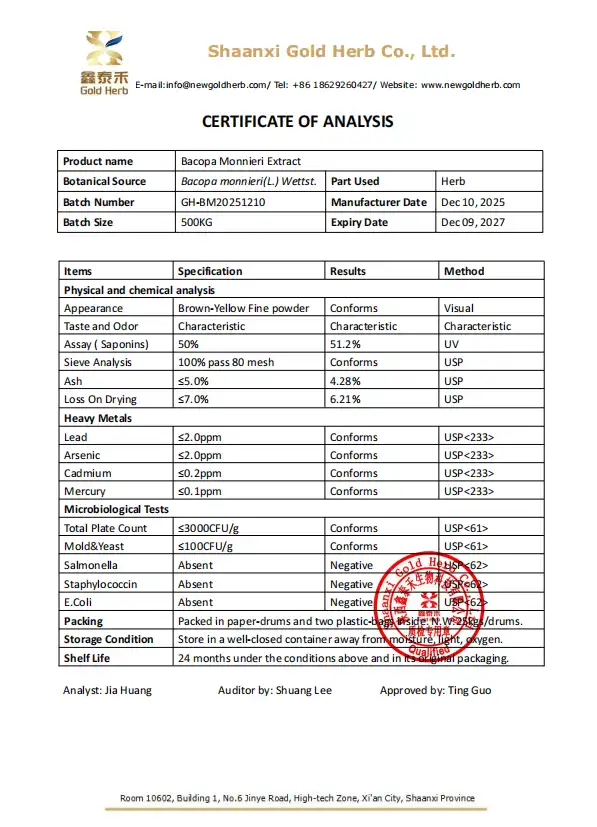
Certificate of Analysis (COA) for Bacopa Monnieri Extract [Request COA]
Understanding Bacopa Monnieri and Its Cognitive Benefits for Kids
Bacopa Monnieri, a perennial herb that grows in wetland areas and is native to India but also found in Asia, Africa, and the Americas, has been used in Ayurvedic medicine for hundreds of years. In modern nutraceutical production, the plant's aerial parts are hydro-ethanolically extracted to make a uniform powder concentrate that usually has 20% to 55% bacosides, as tested by HPLC.
How does Bacopa support children's brain function
Bacosides A and B are the main bioactive triterpenoid saponins that improve brain function. A study in the Journal of Ethnopharmacology shows that bacosides change the cholinergic system by stopping acetylcholinesterase activity. This makes more acetylcholine available, which is a neurotransmitter that is directly linked to memory formation and learning speed. Brahmi extract also lowers lipid peroxidation in neural tissue, which is a very important preventive support for brains that are still growing.
Safety Profile and Pediatric Dosage Considerations
Clinical studies mostly support giving school-aged kids 150 to 300 mg/day of standardized Brahmi extract while being supervised by a medical professional. Side effects that have been reported are mild and short-lived. For example, some people feel sick when they take it on an empty stomach. Bacopa Monnieri is an aquatic plant that can take in heavy metals, so it's important to use pharmaceutical-grade extraction. This way, contaminants are removed to meet USP/EP limits below 10 ppm total heavy metals, which is a quality standard that can't be lowered for pediatric formulations.
How to Use Bacopa Monnieri Extract for Kids' Memory and Learning Enhancement?
Many kids today have real problems with their cognitive development, like not being able to focus, having a weak working memory, and being under a lot of stress at school. Conventional methods focus a lot on behavioral therapies or drug treatments, but parents and doctors are looking for natural options that have been shown to work more and more. This is exactly where medicines made from Brahmi show real value.
Age-Specific Guidance and Product Format Comparison
When making formulas for kids, the form of the product is just as important as how well it works. Here is a comparison of the two most useful ways to deliver:
- Capsule formats are good for kids over 8 years old who can swallow small tablets. They allow for accurate doses, better shelf stability, and compatibility with clean labels. The most popular type of bacopa monnieri extract supplement for kids in the U.S. right now is standardized to 20% bacosides.
- Powder formats give formulators more freedom for younger age groups. Bacopa Monnieri powder mixes well with functional drinks, chewable sweets, and snack bases that have been supplemented. It needs to have its slightly bitter taste covered up, but this is easy to do with food-grade packaging or by matching the flavor with fruit juices.
Both of these forms are aimed at different types of customers, and many well-known supplement brands offer both to reach as many stores as possible. According to clinical monitoring protocols, you should wait 4–8 weeks before checking on cognitive outcomes. This is because the herb is known to start working slowly, as shown in randomized controlled trials.
Comparing Bacopa Monnieri Extract with Other Nootropics for Children
When looking at botanical nootropics for pediatric formulations, people in charge of buying things often compare Brahmi to Ginkgo Biloba and Ashwagandha. Understanding these differences helps you better place your products because each ingredient works in a different way and is safer in different ways.
Bacopa vs. Ginkgo Biloba and Ashwagandha
Ginkgo Biloba mostly increases blood flow to the brain, which makes it more useful for slowing down cognitive loss with age than for helping kids learn. It doesn't have a lot of safety information for kids under 12 yet. Ashwagandha effectively lowers cognitive interference caused by stress in kids, but it has a less direct effect on their ability to remember events. Bacopa Monnieri extract, on the other hand, has been shown in a well-known double-blind study published in Evidence-Based Complementary and Alternative Medicine to improve language learning rate and delayed memory recall in healthy children aged 6 to 12.
Why Standardized Extracts Matter for B2B Buyers?
In the infant market, inconsistent ingredients are not allowed at all. A standardized Brahmi extract that guarantees a fixed bacoside percentage through HPLC analysis gets rid of the changes in phytochemicals that happen with the seasons in raw plant material. According to the Natural Products Insider, over 60% of U.S. supplement buyers now make decisions based on clean labels. Certified organic sources make products even more appealing. When formulation managers are looking at different sources, they should see HPLC-verified strength, organic certification, and heavy metal compliance reports as basic needs, not extras that aren't necessary.
Procuring High-Quality Bacopa Monnieri Extract for Kids: What B2B Buyers Need to Know?
It takes a lot more than comparing prices per kilogram to find the right bacopa monnieri extract supplier. From being able to track down the raw materials to testing the finished extract, quality design tells you if your pediatric product will work regularly and pass legal scrutiny in the U.S. market.
Here are the main qualifications that every purchasing team should check before making a large order:
- Certifications: To meet the needs of a wide range of markets and retail listing standards, suppliers should have FDA registration, ISO 9001, HACCP, and preferably HALAL and Kosher approvals.
- Standardization documentation: Ask for HPLC-based Certificates of Analysis that prove the amount of bacoside in each batch, along with heavy metal test results that meet USP <232> standards.
- Traceability: For pediatric uses, it is essential to be able to fully track the product from where it was grown to where it was extracted and tested.
- OEM/private label capability: Suppliers that can make unique dose forms in less than 20 days will cut your time-to-market by a lot.
- Logistics reliability: Brands need to make sure that U.S. warehouses are stocked, that they have relationships with DHL and FedEx, and that they can meet delivery deadlines of 3–5 business days.
These standards protect the quality of the product and the long-term trustworthiness of your brand in the infant supplement market.
Maximizing the Impact of Bacopa Monnieri Extract in Your Product Portfolio
According to Grand View Research, the market for brain supplements for kids in the U.S. hit $1.2 billion in 2026 and is expected to grow at a rate of 7.4% per year until 2028. Parents are actively looking for plant-based options that are backed by science and fit with their preferences for clean labels. These trends come together in Brahmi extract, which has Ayurvedic roots, modern clinical proof, and a natural positioning that appeals to health-conscious millennial parents.
Adding Brahmi concentrate to a kids' cognitive line works best when the marketing story bases claims on bacoside science instead of vague herbal tradition. When brands are clear about their standardization levels and source quality, customers believe them more and are more likely to buy from them again. Establishing a long-term partnership with a certified, technically savvy provider guarantees the consistency from batch to batch that regulators and store buyers demand and that your brand's image relies on.
Related Products
Conclusion
Bacopa monnieri extract is a naturally occurring substance that has been studied and found to help kids' memory and learning. It works through bacosides, is safe at standard amounts, and can be used in a variety of product forms. These factors make it a useful ingredient for nutraceutical companies that want to target the brain health of kids. The best way for procurement teams to make competitive, legal product lines that appeal to today's smart parents is to put an emphasis on supplier certifications, HPLC-verified standardization, and reliable logistics infrastructure.
FAQ
1. Is Bacopa Monnieri extract safe for children?
Brahmi extract is thought to be safe for school-aged kids when taken in standard doses of 150–300 mg/day. Mild stomach pain has been reported sometimes when taken without food. For kids, you should always talk to a doctor before using anything, and in products for kids, only pharmaceutical-grade Bacopa Monnieri Extracts that meet heavy metal compliance standards should be used.
2. How does Brahmi extract compare to synthetic nootropics for kids?
Bacopa monnieri changes existing neurochemical pathways, especially the cholinergic system, without depleting neurochemicals. This is different from manufactured cognitive drugs. Because it has this adjustable system, it is safer for kids to use for a long time.
3. What should B2B buyers look for when sourcing Bacopa extract in bulk?
Give more weight to suppliers who have heavy metal test reports, FDA registration, ISO/HACCP certifications, and CoAs that have been checked by HPLC. Other things that make procurement easier are OEM flexibility, U.S. warehouse availability, and clear minimum order quantities.
4. Is organic Brahmi extract worth the premium for pediatric products?
Organic approval lowers the risk of chemical residue and supports clean label claims. These are two very important things in the supplement category for kids. Certified organic Brahmi extract is a great way for brands that want to sell natural products to set their products apart.

Partner with Gold Herb for Premium Bacopa Monnieri Extract Supply
Gold Herb offers pharmaceutical-grade bacopa monnieri extract sales services that are specifically made for supplement brands for kids. Our HPLC-standard Brahmi powders are certified by FDA, ISO 9001, HACCP, HALAL, and Kosher, and we have stock in U.S. warehouses that let us ship within 3–5 working days. We help with OEM and private label creation, and the whole process can be finished in less than 20 days. To get samples and CoA paperwork, email our technical team at info@newgoldherb.com.
References
1. Roodenrys, S., et al. — Neuropsychopharmacology, 2002.
2. Stough, C., et al. — Psychopharmacology, 2001.
3. Calabrese, C., et al. — Evidence-Based Complementary and Alternative Medicine, 2008.
4. Morgan, A., & Stevens, J. — Journal of Alternative and Complementary Medicine, 2010.
5. Pase, M. P., et al. — Journal of Alternative and Complementary Medicine, 2012.
6. Bhattacharya, S. K., & Ghosal, S. — Journal of Ethnopharmacology, 1998.

Send Inquiry
Related Industry Knowledge
- Tongkat Ali Extract Benefits for Athletic Performance
- What is the difference between astaxanthin and zeaxanthin?
- Kava Extract Manufacturing Process, Benefits & Applications
- Astaxanthin vs Collagen: Which Is Better for Skin Health?
- Fisetin vs Curcumin: Key Differences and Benefits
- Ergothioneine vs Resveratrol: Best Longevity Ingredient Compared
- What Is Ergothioneine? Benefits, Antioxidant Power & Bulk Supply
- What About Coconuts, Coconut Milk, and Coconut Oil MCTs?
- Fisetin Benefits for Brain Health and Longevity
- GMP Fisetin Powder for Pharmaceutical R&D Use