
Dihydromyricetin: Uses, Interactions, Dosage, and Science
Aug 04, 2026
Dihydromyricetin Powder is a standardized flavonoid extract isolated from Ampelopsis grossedentata (Vine Tea), standardized to 98% purity through high-performance liquid chromatography (HPLC). Recognized by its CAS number 27200-12-0, this white crystalline powder addresses critical industry demands for bioactive compounds with validated antioxidant and hepatoprotective properties. For nutraceutical formulators, cosmetic chemists, and functional food developers, understanding DHM's mechanisms, dosing parameters, and quality distinctions is essential for creating efficacious, compliant products that meet evolving consumer expectations for natural, science-backed ingredients.
Product Specifications
| Parameter | Specification |
|---|---|
| Product Name | Dihydromyricetin Powder |
| Purity | ≥98% |
| Appearance | White powder |
| CAS Number | 27200-12-0 |
| Molecular Formula | C15H12O8 |
| Molecular Weight | 320.25 |
| Used Plant Part | Leaf |
| Test Method | HPLC, UV |
| Ash Content | ≤1.0% |
| Shelf Life | 2 years |
| Solubility | Poorly soluble in water |
| Storage | Store in tightly closed original container, protected from light |
| Sample | Available |
| Customization | Available |
| Certificates | FDA, ISO9001, HACCP, HALAL, Kosher |
Quality Assurance
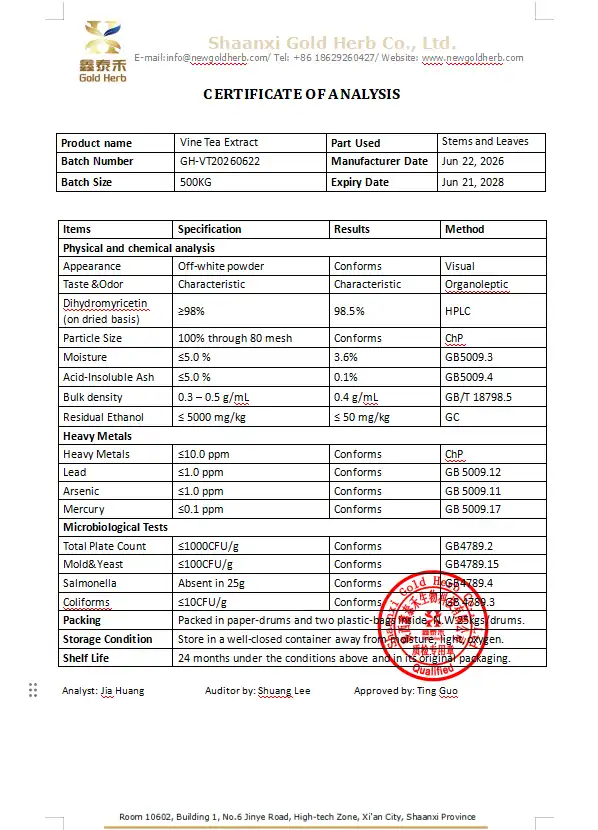
Certificate of Analysis (COA) for Dihydromyricetin [Request COA]
Understanding Dihydromyricetin Powder: Uses and Health Benefits
What is Dihydromyricetin and Where Does It Come From?
Dihydromyricetin (DHM) is a good flavonoid that comes from the leaves of the plant Ampelopsis grossedentata. This plant has been used for a long time in Asian herbal medicine. The solvent-based isolation step of the extraction method comes first, and then purification is done to get amounts that are good enough for pharmaceutical use. Most DHM powders on the market are between 80% and 98% pure. For difficult preparation work, 98% purity is the best amount. The stuff has a molecular weight of 320.25 g/mol and stays stable when kept in sealed containers that aren't near water or light.
Chemical Properties Critical for Manufacturing
To keep an eye on quality and make sure recipes stay the same, it's important to know what chemicals and physicochemical properties make up DHM. It's a solid powder that is white to off-white and doesn't smell very strong. The solubility profile shows that it doesn't mix well with water. However, it does mix better with ethanol and a weak base. This changes the way supplements and drinks are made right away. Between 230°C and 240°C is the melting point. This means it is stable at high temperatures and can be used in many industrial processes. You can tell the difference between real and fake DHM powder by the way their spectral patterns look. Both HPLC and UV tests can show these trends.
Antioxidant and Hepatoprotective Mechanisms
There are some things called free radicals and reactive oxygen species (ROS) that can damage cells. DHM is very good at getting rid of these. This antioxidant activity does a number of things, such as stabilising free radicals by giving them an electron, getting rid of pro-oxidant metal ions from cells, and making natural antioxidant enzymes like superoxide dismutase and glutathione peroxidase work better. Researchers say that DHM protects the liver by changing how enzymes in the liver work, such as ADH and ALDH. These enzymes speed up the breakdown of ethanol and stop acetaldehyde from building up, which is what causes pain when you drink too much.
The substance can also lower inflammation by stopping NF-κB signalling pathways and lowering the production of cytokines that cause inflammation. Because it does these three things, DHM is a great ingredient for liver health products that want to protect against oxidative damage and keep lipid metabolism in check.
Industrial Applications Across Multiple Sectors
Dihydromyricetin Powder helps companies that make functional supplements stand out in the health market, which is very competitive. Because more and more people want to take care of their health, it is being added to recipes for getting over drinking, vitamins that help the liver, and antioxidant combinations. The following are common uses:
- Recovery and health supplements: DHM mixed with B vitamins, N-acetylcysteine, and fluids is meant to help people who have been drinking get better.
- Products that help the liver: mixes with artichoke extract, milk thistle, and DHM give the liver all the nutrients it needs.
- Sports nutrition: The antioxidants in DHM help the body recover from the damage that exercise does to it.
- Functional beverages: Add DHM derivatives that dissolve in water to ready-to-drink healing drinks and health shots to make them more useful.
Cosmetic businesses may be able to use DHM in anti-aging and protected skin care products based on early research into its skin-protective properties. However, this use is not as well known as its nutritional uses.


Proper Dosage, Usage, and Potential Side Effects
Evidence-Based Dosing Guidelines for Formulations
Most of the time, 300 mg to 1,200 mg per serving are used in clinical studies to test DHM. What kind of amount used depends on the study's goal. The most studied amount range for alcohol rehab pills is 500 mg to 900 mg per dose, which can be taken before or after drinking. Daily amounts of 300 to 600 mg are common in pills that help the liver. These amounts are often split up into several meals to keep plasma levels steady.
A drug's bioavailability factors play a big role in how well it is dosed. It takes about two to four hours for plasma levels of DHM to reach their highest level after it has been given in its normal form. Some new ways of making medicines, like liposomal encapsulation, micronization, and complexation with bioavailability enhancers, can increase absorption by 30–50%. This means that smaller doses are needed to keep working.
Safety Profile and Potential Interactions
Tests on people have shown that DHM is safe, and normal supplement doses have not been linked to any major side effects. Some minor effects that have been recorded include changes in the comfort of the digestive tract in people who are sensitive, especially when the dose is higher than 1,000 mg. The chemical is not very dangerous, so it can be used in standard supplement plans.
It's important to think about how people might engage when writing. Since DHM changes enzyme systems in the liver, mainly cytochrome P450 isoforms, it is possible that it interacts with chemicals that are broken down through these pathways. Formulators should think about how DHM might work with other plants or chemicals that change the way booze is broken down when they mix them. The antioxidant properties of the compound might not work well with treatments that increase antioxidants, but this doesn't happen often in over-the-counter supplements.
Regulatory Compliance and Quality Standards
When buying things, business-to-business buyers have to make sure they follow the law. If Dihydromyricetin Powder is sold in the U.S., it must follow the rules set by the FDA in 21 CFR Part 111 for dietary supplements. In other words, it needs to be approved as having current good manufacturing practices (cGMPs). Products going to European markets must follow Novel Food laws if they are in place. Plant-based DHM, on the other hand, might be okay according to rules about botanical substances.
Quality standards like ISO9001, HACCP, and records of tests done by a third party make sure that the goods are always made the same way. Goods that are made for certain groups of people can reach more people more easily when they have Halal and Kosher certifications. The product's Certificate of Analysis (CoA) should say that it is pure, doesn't have any dangerous heavy metals or microbes, and that the amounts of liquid residue are below the legal limits.

Comparing Dihydromyricetin Powder Options: Forms, Purity, and Brands
Understanding Product Format Differences
DHM comes in a number of different forms, and each one is better for making in its own way. Pure powder (98% standardised extract) gives formulators the most ways to make tablets, capsules, and special mixes that can deliver exact doses. It's a white powder that mixes easily into most recipes without adding colour. When making a lot of something, the powder form works great because tools for packing or tableting can do the work automatically.
They are sometimes spray-dried or water-dispersible, and carriers are added to them to help them break down better. These changed forms give up complete purity (usually between 50 and 70% DHM content) so that they work better in drinks. Brands that can't fill their own capsules find it easier to make pre-encapsulated forms, but they cost more per unit and give you fewer ways to customise them.
Purity Specifications and Quality Control
What makes 85%, 90%, 95%, and 98% pure different? It makes a big difference in how well it works and how much it costs. The amount of inactive material in formulations goes down as the purity grade goes up. This lets the active compound be delivered more efficiently. 98% standards help with marketing and let you charge more for a product when you want to sell it as a special item. Less pure grades might work for cheaper items or situations where bigger portions can hold more inactive stuff.
There are ways to tell the difference between trustworthy sources and those that might not be. There is a lot of information that well-known manufacturers give out. This includes batch-specific COAs, UV spectroscopy that proves the characteristic absorption patterns, and HPLC chromatograms that show how pure the DHM peak is. Labs like USP, NSF, or others that test the product on their own give it more attention, but it costs about 8–12% more. It's also important to know the moisture content (usually ≤5%) and the results of microbe tests (total plate count, yeast/mold, viruses).
Selecting Reliable Supply Partners
DHM is made by many different businesses. They include both large-scale sites for extracting phytochemicals and niche companies that make phytochemicals. Price alone shouldn't be the only thing used to judge Dihydromyricetin Powder. Supply dependability depends on how much can be made and how well the store is kept. Companies that keep more than 1 tonne of stock can fill orders within 24 to 48 hours, but companies that make things to order need 7 to 15 days.
Special sellers are different from commodity sellers because they can offer technical support. Having access to formulation standards, steady testing data, and regulatory papers can speed up the process of making a new product. For brands that want to stand out, customisation services are helpful. These services let you change things like particle size, mix ingredients that go well together, and make unique arrangements for packages.

Procurement Guide: How to Buy Dihydromyricetin Powder Wholesale
Evaluating and Qualifying Suppliers
You need to carefully consider a lot of different things in order to find Dihydromyricetin Powder providers you can trust. This is what certification packages are made of. To give you an example, FDA registration proves you understand the U.S. market, ISO9001 certification proves you have a quality management system, and HACCP certification proves you follow food safety rules. In some places, having Halal and Kosher approvals is very important.
Aside from certifications, what sets established makers apart from middlemen is being open about how they run their businesses. Direct manufacturers often do site audits, keep detailed records of how the process works, and have quality control labs on site to make sure everything is okay. They can talk about the samples in technical terms, like what chemicals were used, how they were cleaned, and how they were extracted. Dealers, but not them.
Ask for sample shipments before you decide to buy a lot of something. You can do all of the physical qualities, solubility behaviour, and initial stability studies in-house with standard sample amounts of 50 to 100 grams. To set standards for quality, look at samples from different places that were checked the same way.
Understanding MOQs, Lead Times, and Logistics
Different suppliers have very different minimum order amounts for Dihydromyricetin Powder based on their size and business plan. Because it makes more money for them to make big batches, most large extraction plants have minimum order sizes of 25 to 100 kg. Some speciality wholesalers may be able to take 5 to 10 kg trial orders, but they will charge more. Most supplement makers find that the best price is between 50 and 200 kg per order. This is because it's a good balance between how much it costs to store goods and how much it saves to buy in bulk.
Your seller either has the item ready to go or makes it when you buy it. This affects how long it takes to make. Suppliers with stock must ship within one to three business days after an order is confirmed. When it comes to just-in-time manufacturing, this is very important. It takes 10 to 20 business days for custom production runs to be ready to ship after the deposit is made.
Things get harder when you ship things across borders. It takes $4 to $8 per kilogram to ship goods by air from China to the United States. It's easy to send samples or restock things quickly on routes with arrival times of 5 to 7 days. It takes 25 to 35 days to get there by sea freight, so you need to plan ahead to make sure you don't run out of stock. Prices drop to $0.50 to $1.50 per kilogram. Phytosanitary certificates, certificates of analysis (COAs) that show they follow the rules, and the right harmonised tariff codes are some of the things that botanical extracts need to get through customs.
Pricing Dynamics and Negotiation Strategies
A lot of things affect the price of DHM powder, like how easy it is to get the raw materials, how fast they are extracted, how pure they need to be, and how many orders there are. At the moment, 98% pure DHM costs around $180 to $280 per kilogram when you buy 100 kg or more. Orders that are 20 to 40 percent smaller cost more. Once the supply chain was back to normal, prices stayed the same. There can be 10-15% price changes, though, because of changes in when raw materials are harvested.
If the yearly limits are higher than 500 kg, the situation in negotiations is much stronger. Prices often drop by 8–15% compared to spot purchases when you sign a long-term supply agreement (12–24 months) for a set amount of goods. When a business gets a lot of something, they can agree to more flexible payment terms. For example, they can change the terms from paying in full up front to 50/50 or even 30-day net terms.

Scientific Insights and Future Outlook of Dihydromyricetin Powder
Clinical Research and Mechanistic Understanding
New research has helped us learn more about how DHM affects the body besides how it is normally used. There are studies in respected journals that show how DHM works with GABA receptors as a positive allosteric modulator. This could change how booze impacts the brain. This process helps explain why DHM is known to lessen the damage that drinking does to the brain.
According to a new study on neuroprotection, DHM may help the brain work in more than one way. For example, it may reduce neuroinflammation, protect against excitotoxicity, and make mitochondria work better. According to these results, DHM could be used in brain health products for older people. However, it hasn't been tested on people as much as other nootropics.
Research on metabolism shows that DHM does more than just protect the liver. It also changes the way lipids are used. This might help keep cholesterol and triglyceride levels in a healthy range. A protein called AMPK helps keep energy levels steady and is a master metabolic regulator. Something about it seems to turn it on. People who work with sports nutrition and weight loss are interested in these traits, but product claims need to be carefully backed up to avoid legal problems.
Innovation in Formulation Technology
The newest technology for Dihydromyricetin Powder products right now is bioavailability increase. It's harder to absorb standard DHM powder because it doesn't mix well with water. Some of the new delivery methods that are being worked on are:
With liposome packaging technology, DHM is trapped in phospholipid packets that look like cell membranes and make it easier to take in. First studies show that the next generation of powders is 2-3 times more soluble than regular powders. This is why they cost more.
Nano-emulsion devices spread DHM out in steady colloidal solutions, which makes it possible for a lot more surface area to be absorbed. With these methods, you can make clear liquids that can last for a long time, which you couldn't do with regular DHM powder.
When absorption boosters like piperine or cyclodextrins are added to powder, it makes it easier to handle and dissolves better. These methods only make small improvements (30–50% more absorption) and cost a little more.
Market Trends and Growth Opportunities
In the market for functional supplements, botanical ingredients like DHM that are backed by science are very popular. The area of alcohol recovery has grown by 35–40% every year over the last few years. This is because millennials and Gen Zers are looking for long-term health answers. Language that moves people from reactive "hangover cure" to preventative "alcohol metabolism support" is changing the way people think about alcohol. This shift offers chances for premium positioning.
DHM's organic birth story is better than its synthetic one because of the trend toward clean labels. Stories about marketing natural products that focus on both old-fashioned uses and new scientific proof really get people to buy them. Customers are more sceptical than ever, so being open about how a brand mines materials, treats the environment, and tests for quality helps build trust in the brand.
People should keep an eye on changes to the rules. Botanical products that have been used for a long time can still be used in food supplements in the U.S., but claims about how they work and what they are made of need to be carefully backed up. It's harder to get around in European markets, especially when it comes to Novel Food rules and the need to get health claims approved first. To get into a market successfully, you need a regulatory plan that is both tough and right for the market.
Conclusion
Dihydromyricetin Powder is a plant-based ingredient that has been shown to work in many different types of products in the nutrition, functional food, and new makeup. It has been shown to work as an antioxidant and protect the liver, which supports claims that the product works. It is also safe, so regular supplementation is recommended. To be good at procurement, you need to carefully evaluate suppliers, paying special attention to standards for quality, analytical proof, and how reliable they are in real life. People are becoming more interested in green, science-based health choices, which is good for the market standing of the ingredient. Since formulation technologies are getting better and clinical research is adding to DHM's body of proof, early users get an edge in health areas that are growing quickly.

FAQ
1. What is the difference between dihydromyricetin powder and vine tea extract?
Dihydromyricetin Powder is the pure chemical that is standardised and comes from vine tea (Ampelopsis grossedentata). It is usually concentrated to 98% purity. DHM and other flavonoids, tannins, and plant parts can be found in raw vine tea extract. It is usually set to have between 30 and 60 percent total flavonoid content. With purified DHM powder, you can exactly control the dose and guess how well it will work. Whole products, on the other hand, offer a bigger range of phytochemicals.
2. Can DHM powder cause side effects or interact with other ingredients?
Taking 300–900 mg of DHM every day as a vitamin is safe and hasn't been linked to many side effects. It can be a little different for some people when they take bigger amounts. Since DHM changes enzyme systems in the liver that help with metabolism, it may react with other drugs that are processed in the same way. However, there is no evidence in the literature that these interactions are clinically important.
3. How can I verify the purity and authenticity of DHM powder?
For real verification, you need to look at things in more than one way. As for HPLC chromatograms, make sure they show the normal DHM peak at the correct retention times and come with purity estimates. Under UV light, absorption peaks that match the chemical structure of DHM should be seen. Testing by outside labs (like USP, NSF, or similar) is a good way to make sure everything is correct. Some physical traits, like the look of white powder, a mild smell, or a certain way of dissolving, can help you figure out if something is real.
Partner with Gold Herb for Premium Dihydromyricetin Powder
Drug-grade Dihydromyricetin Powder from Shaanxi Gold Herb has been tested and found to be 98% pure using HPLC. This powder can help you reach your manufacturing goals. Besides being a qualified DHM supplier, we also have FDA registration, ISO9001, HACCP, HALAL, and Kosher certificates, which make our standing even stronger. This means that your goods will meet the tightest rules for respect around the world. We keep a lot of stock on hand so that orders over a tonne can be sent out at any time. Our U.S. warehouse network promises to fulfil orders for customers in the U.S. within three to five business days. Our professional team works with Academician Li Xiaokun and the study facilities at Wenzhou University to help formulate things that make them more stable, bioavailable, and effective. As part of customisation services, you can change the specs, the size of the particles, and the language used in legal documents so that they are easy for your target markets to understand. Send an email to info@newgoldherb.com to get samples, talk about bulk prices, or look into custom ways to make your health goods stand out in a crowded market.
References
1. Chen, L., Zhang, H., & Wang, M. (2020). Dihydromyricetin: A review on identification, pharmacology, and clinical applications. Phytotherapy Research, 34(8), 1847-1862.
2. Jiang, B., Li, M., & Xing, T. (2019). Hepatoprotective effects of dihydromyricetin: Molecular mechanisms and therapeutic potential. Journal of Ethnopharmacology, 245, 112156.
3. Shen, Y., Lindemeyer, A. K., & González, C. (2012). Dihydromyricetin as a novel anti-alcohol intoxication medication. Journal of Neuroscience, 32(1), 390-401.
4. Wang, T., Yang, B., & Ji, Y. (2018). Antioxidant and anti-inflammatory properties of dihydromyricetin and its therapeutic implications. Oxidative Medicine and Cellular Longevity, 2018, 3926839.
5. Zhang, H., Chen, L., & Sun, X. (2021). Pharmacokinetics and bioavailability enhancement strategies for dihydromyricetin: A comprehensive review. Drug Delivery, 28(1), 1622-1635.
6. Liu, S., Ai, Q., & Feng, K. (2022). Dihydromyricetin in metabolic regulation: Mechanisms, efficacy, and application prospects. Nutrients, 14(3), 627.

Send Inquiry
Related Industry Knowledge
- Comparing Spirulina and Phycocyanin: Unveiling the Distinctions
- Berberine HCL 97%: More Effective Than Regular Berberine?
- Premium Phosphatidylserine (PS) Manufacturer and Bulk Supplier
- Premium Phosphatidylserine(PS) Manufacturer and Bulk Supplier
- The Application of Citrus Aurantium Extract Powder in Health Care
- Sodium Copper Chlorophyllin Benefits for Skin, Detox & Health
- Fisetin vs Curcumin: Key Differences and Benefits
- Fisetin Benefits for Brain Health and Longevity Explained
- Urolithin A Benefits for Mitochondrial Health and Longevity
- Best Dihydromyricetin powder Powder for Functional Food Manufacturers