
Ergothioneine Powder Manufacturing Process and Quality Standards
Jul 30, 2026
Ergothioneine Powder represents a breakthrough in natural antioxidant technology, offering nutraceutical, cosmetic, and pharmaceutical manufacturers a rare sulfur-containing amino acid with exceptional cellular protection capabilities. Produced through precision microbial fermentation and rigorous purification protocols, this off-white to white crystalline powder achieves ≥99% purity (CAS 497-30-3), verified by HPLC testing. Its unique molecular structure—featuring thiol-thione tautomerism—delivers unmatched stability across demanding formulation environments while providing targeted cellular uptake through the OCTN1 transporter mechanism, solving critical industry challenges around antioxidant bioavailability and batch consistency.
Product Specifications
| Parameter | Value |
|---|---|
| Appearance | Off-white to white powder |
| Purity | ≥99% |
| CAS Number | 497-30-3 |
| Molecular Formula | C₉H₁₅N₃O₂S |
| Molecular Weight | 229.3 |
| Test Method | HPLC |
| pH (50mg/mL, 20℃) | 6.0-7.5 |
| Melting Point | 270-271℃ |
| Loss on Drying | ≤0.5% |
| Particle Size | 100% pass 50 mesh |
Quality Assurance
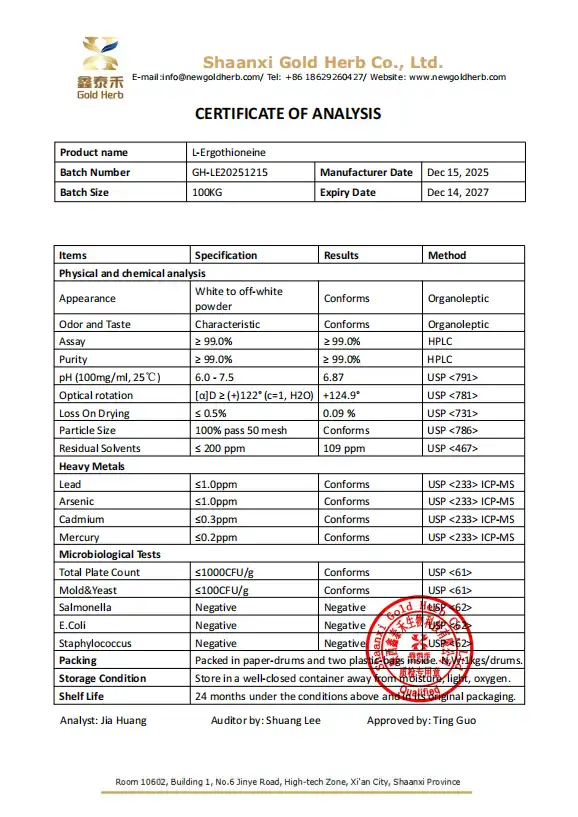
Certificate of Analysis (COA) for Ergothioneine Powder [Request COA]
Understanding Ergothioneine Powder and Its Industrial Significance
The market for anti-aging and cytoprotective ingredients is still changing quickly. This is because people want natural bioactive molecules that have been proven to work by science. As a result, L-ergothioneine has become known as a "longevity vitamin" by experts. It is a naturally occurring amino acid product that was first isolated from the ergot fungus in 1909 and is now known for its amazing ability to protect cells.
Defining Ergothioneine: From Natural Sources to Biotechnological Innovation
You can find ergothioneine naturally in some bacteria, plants, and mushrooms, especially King Trumpet and Shiitake types. However, traditional extraction from these sources has a lot of problems, such as low yield rates (often less than 0.05% by dry weight), changes that happen with the seasons, and the chance of contamination that makes it hard to meet pharmaceutical-grade purity standards. Modern manufacturing has strongly shifted toward advanced microbial fermentation using specially selected strains of bacteria or yeast. This makes it possible to consistently produce high-purity material with the molecular formula C9H15N3O2S and exact L-isomer chirality, which can be confirmed by specific rotation values between +122° and +128°.
This change in production addresses basic concerns about buying things. When looking at possible ingredients, R&D leaders need to know that the active ingredients will work the same way in all production batches. This is hard to promise with wild-harvested materials, but it's standard with Ergothioneine Powder that comes from fermentation and meets pharmaceutical-grade standards.
Critical Quality Parameters for B2B Procurement
When purchasing teams look at ergothioneine providers, they should focus on a few quality factors that can't be negotiated. For normal uses, the purity level must be at least 98.0%. For pharmaceutical and high-end cosmetic formulas, premium grades must hit at least 99.0%. It dissolves easily in water (more than 100 mg/mL at 25°C) and can withstand temperatures up to 100°C, which is better than highly sensitive antioxidants like vitamin C. This makes it easy to use in goods that are made with water.
Bioavailability is another thing that sets them apart. Normal antioxidants work by passive diffusion, but ergothioneine uses a special cellular transport system (OCTN1) to make sure it gets into organs like skin, liver, and red blood cells quickly and effectively. This is the reason why formulators are asking for ergothioneine more and more in products that are meant to protect against photoaging, oxidative stress, and maintain mitochondrial health.
Regulatory Landscape and Market Growth Drivers
The global market for ingredients containing ergothioneine has grown a lot. This is especially true in the US, where "wellness from within" marketing and "clean label" trends drive new formulations. The ingredient has come a long way in being accepted by regulators. It is now generally recognized as safe (GRAS) for use in food and meets the rules for beauty ingredients set by both the FDA and the EU when made according to Good Manufacturing Practice (GMP) standards.
Ergothioneine is stable during standard pasteurization processes and works well with beverage matrices, which is why functional food developers like it. Cosmetic scientists like how it works with other active ingredients, like niacinamide or hyaluronic acid, to make anti-aging products that do more than one thing. Pharmaceutical R&D teams are looking into how it could be used in medical nutrition products to treat inflammatory conditions and the loss of cells that comes with getting older.

Ergothioneine Powder Manufacturing Process Explained
Modern Ergothioneine Powder production uses advanced bioengineering to balance the effectiveness of microbes with strict quality controls that meet pharmaceutical standards. Knowing about these steps of production helps procurement pros judge the skills of suppliers and plan for possible supply chain issues.
Fermentation-Based Production: The Industry Standard
Modern production starts with carefully picking microbial types, which are usually bacteria or yeast that have been changed to improve ergothioneine metabolism. These microorganisms are grown in bioreactors that are controlled so that the temperature, pH, oxygen levels, and nutrients are constantly checked and adjusted. Real-time monitors and automated feedback loops are used in advanced bioreactor systems to keep the conditions at their best, which maximizes yield while minimizing unwanted leftovers.
During the fermentation phase, which lasts for 72 to 120 hours on average, bacteria use their own natural biochemical pathways to turn simple carbon and nitrogen sources into ergothioneine. Ergothioneine levels of 5–15 g/L in fermentation broth are reached in modern facilities, which is a huge improvement over old methods and necessary for making the business work.
Purification and Crystallization: Achieving Pharmaceutical-Grade Quality
After fermentation, the soup goes through several stages of cleaning to get rid of cell debris, leftover nutrients, and other waste products from metabolism. To sort the biomass, this method usually starts with microfiltration or centrifugation. Next, advanced chromatographic techniques are used. Ion exchange chromatography works especially well because it uses ergothioneine's special charge properties to separate very pure substances.
Activated carbon treatment gets rid of color bodies and small amounts of organic impurities, and ultrafiltration makes the clean solution stronger. Crystallization is the last step in the purification process. It involves carefully controlling the cooling and the solvents so that ergothioneine forms pure crystals. The crystals are collected, washed with pharmaceutical-grade liquids, and dried slowly in a vacuum to keep them from breaking down at high temperatures.
Careful monitoring is needed during the drying process, which usually involves vacuum drying at temperatures below 60°C or freeze-drying (lyophilization) for higher grades. This makes the off-white to white powder that has a moisture content of less than 0.5%, which is needed for long-term stability and accurate dosing in finished products.
Process Controls and Scalability Considerations
Process Analytical Technology (PAT) is used by top manufacturers throughout the whole production process. This allows for real-time quality monitoring and quick corrections. During processing, in-line HPLC analysis checks the concentration of ergothioneine, and automatic pH and conductivity checks make sure the best conditions for separation. These controls give OEM makers the batch-to-batch stability they need to meet regulations and make sure their products work well.
Scalability is an important thing to think about for brands that are growing. Reliable sellers keep their production capacity flexible so they can meet requests ranging from small batches of a few kilograms for testing purposes to large numbers of several tonnes for mass production. Customized specifications usually have production lead times of 7 to 15 working days. Reliable suppliers keep a strategic stock of standard grades so that urgent needs can be met right away.

Quality Standards and Testing Protocols for Ergothioneine Powder
Quality assurance is what sets premium suppliers apart from commodity sellers. This is especially true for bioactive ingredients, where purity and potency have a direct effect on how well a product works and how safe it is for consumers. Procurement teams can trust long-term sourcing partnerships that are based on thorough testing protocols and well-known certifications for Ergothioneine Powder.
Essential Certifications and Compliance Frameworks
Top ergothioneine makers have a lot of certificates that show they are committed to quality and following the rules. ISO 9001 approval makes sure that quality management systems meet international standards. This makes sure that processes are always the same and that things are always getting better. Certification in ISO 22000 or HACCP makes sure that food safety risks are found and managed in a planned way. This is very important for dietary supplement and functional food uses.
FDA registration and GMP compliance are the minimum standards to get into the U.S. market. Other qualifications, like Halal and Kosher, make it easier to get into markets around the world. These certifications need to be checked by a third party on a regular basis. This makes sure that the manufacturing standards are being met by a third party. Gold Herb keeps its FDA, ISO9001, HACCP, HALAL, and Kosher certifications up to date. This makes sure that our Ergothioneine Powder meets the different rules and regulations in different countries.
Comprehensive Quality Control Testing
Each production batch is checked for quality by strict scientific testing before it is released. HPLC analysis proves the sample's identification and assay, making sure that the amount of ergothioneine present meets or exceeds the required level (usually ≥99.0%). This testing also looks for related substances and breakdown products to make sure the chemicals are pure.
Protocols for microbial testing check for specific pathogens like Salmonella, E. coli, and yeast and mold levels, as well as the total aerobic count. Staphylococcus aureus and E. coli. Material that is used in pharmaceuticals has to meet strict standards, like having less than 1,000 CFU/g of total aerobic count and no pathogens in 25g samples.
Heavy metal screening keeps the atmosphere safe from harmful chemicals. Usually, acceptance standards call for lead levels below 1 ppm, arsenic levels below 1 ppm, cadmium levels below 0.5 ppm, and mercury levels below 0.1 ppm. Analysis of residual solvents makes sure that any working solvents stay below the limits set by the ICH. Studies of stability at high temperatures (40°C, 75% relative humidity) and real-time tracking of storage give information on shelf life and help make storage suggestions.
Supplier Audit Considerations for Procurement Teams
When looking at possible ergothioneine sources, people who work in buying should look at more than just certifications. Ask for detailed process validation documentation and manufacturing flow diagrams. Look at batch records that show the same analysis results in different production runs. Tight standard errors in assay values are a sign of good process control.
Check out what the supplier's quality lab can do. HPLC devices, bacteria testing facilities, and the right reference standards should all be kept on hand for in-house analysis. Ask for Certificates of Analysis from the most recent batches to make sure that the testing methods are in line with pharmacopoeial standards and best practices in the business.
Being clear about where the raw materials come from builds trust. Manufacturers with a good reputation have clear source approval programs that make sure fermentation substrates meet standards for food or medicine. Traceability systems should be able to keep track of everything from the raw materials to the finished product. This will help with regulatory compliance and allow for quick action if quality problems arise.
Comparing Ergothioneine Powder: Sources, Forms, and Supplier Selection
Strategic sourcing choices involve more than just comparing prices. They also involve technical details, the supplier's skills, and the possibility of a long-term relationship. When procurement managers know the ins and outs of the different ways to get ingredients, they can choose ingredients that fit with their brand's positioning and product development goals for Ergothioneine Powder.
Fermentation-Derived versus Mushroom-Extracted Ergothioneine
While marketing stories sometimes focus on "natural extraction," ergothioneine that comes from fermentation has a lot of benefits for commercial uses. It is impossible to get uniform purity (≥99.0%) with plant extraction because co-extracted chemicals make purification harder and cause batch differences. The molecule is the same no matter how it is made—both produce L-ergothioneine with CAS 497-30-3—but fermentation gets rid of worries about herbicide leftovers, heavy metal contamination from soil buildup, and yearly supply changes.
Fermentation on a commercial scale is best when it saves money. A lot of raw materials are needed to separate ergothioneine from mushrooms—often 10,000 kg or more to get 1 kg of pure ergothioneine. This makes the process expensive and environmentally harmful. Production through fermentation achieves pharmaceutical-grade purity at prices that allow wider market adoption, especially for dietary supplements that need to be taken every day.
Powder Form Advantages for Product Development
Ergothioneine Powder gives you more options for how to use it than liquid concentrates or capsules. The solid powder form allows accurate measuring and mixing, which is necessary to meet label claims and make sure that doses are the same across production runs. Because it dissolves easily in water, it can be added to drinks, serums, and other water-based mixtures without the need for special methods for dissolving.
The powder's stability makes it useful for a wide range of applications. Some antioxidants need to be kept in the fridge, but Ergothioneine Powder can stay effective at room temperature for 24 months or longer if it is stored correctly. This makes it easier to keep track of supplies and lowers the cost of cold-chain operations. Ergothioneine is very stable even when it's added to finished goods, where it works well with common ingredients and processing circumstances.
Evaluating Supplier Capabilities and Service Models
When choosing a supplier, you should look at more than just the product specifications. Production ability is very important. Can the seller grow with your business, or will there be problems as volumes rise? When it comes to supply security, manufacturers with dedicated fermentation facilities and well-established scale-up protocols are better than brokers or small-scale producers.
Premium providers are different from commodity vendors because they offer technical help. Having access to formulation scientists who know how ingredients interact, how to keep the product stable, and how to meet regulatory requirements speeds up the development process. Gold Herb offers full technical support thanks to its partnership with Academician Li Xiaokun's team and the R&D resources of Wenzhou University. These resources provide expertise in screening anti-aging ingredients and proving their effectiveness.
Logistics infrastructure has a big effect on lead times and how reliably orders are filled. Strategic inventory kept by suppliers in target markets, like Gold Herb's permanent U.S. warehouse stock, allows standard specs to be delivered in 3–5 days, which cuts the time it takes to get a product to market by a huge amount. For custom formulations, streamlined processes should get them to you within 20 days of receiving the final specifications.
Customization that is flexible meets the needs of brand identity. The best suppliers can customize solutions for things like particle size optimization, custom assay levels, special packaging (like nitrogen-flushed or desiccant-protected), and private labeling. These services are especially helpful for brands that want to protect their unique branding or meet strict recipe needs.
Best Practices for Handling, Storage, and Usage of Ergothioneine Powder
Good management after purchasing keeps the quality of the ingredients and increases the return on investment. Using handling protocols that are based on evidence will make sure that the high-purity Ergothioneine Powder you've bought works as expected throughout its entire life.
Recommended Dosage Ranges for Various Applications
Scientific literature and market research show dosage suggestions that are specific to each application. Dietary supplements usually have between 5 and 20 mg of ergothioneine per serving. Daily doses of 5 mg or more have been shown to be beneficial in clinical studies. Some cosmetics have 0.1% to 1.0% ergothioneine by weight, and concentrations around 0.5% work best for photoprotection and anti-aging effects without making the recipe harder to work with.
Functional drinks usually have between 2 and 10 mg per dose, which is a good balance between how well they work and how much they cost for everyday use. Higher amounts (20–50 mg per dose) may be found in pharmaceutical-grade medical diet items, especially for managing oxidative stress. These ranges show both the levels of effectiveness found through study and the actual formulation economics.
Optimal Storage Conditions and Stability Maintenance
Even though ergothioneine powder is naturally stable, it can last even longer if stored correctly. Keep containers cool and dry. For long-term storage, the best temperature range is between 2°C and 8°C, but room temperature (15°C to 25°C) is fine for items that are used often. The relative humidity should stay below 60% so that the powder doesn't absorb water, which could make it harder to flow.
Protect things from direct light, especially UV rays, which can speed up the reactive breakdown process over time. Store things in dark places or containers that don't let light through. If you can, keep the packaging in an inert atmosphere. Flushing with nitrogen or vacuum-sealing the packaging reduces oxidative exposure while it is being stored. Once containers are opened, they should be quickly sealed again, and parts might need to be moved to smaller containers so that bulk inventory doesn't have to be exposed to oxygen and moisture in the air over and over again.
Put the date of receipt, the lot number, and the retest date (usually 24 months from manufacture for premium grades) on each container. Use first-in, first-out product movement to make sure that your goods stay as fresh as possible. Re-analyze saved materials on a regular basis, especially stock that has been kept for more than 18 months, to make sure that the assay values are still within the acceptable range before using the recipe.
Integration Tips for Formulation Development
Ergothioneine works very well with antioxidants that work in a similar way, which lets scientists make formulations that work better together. When mixed with vitamins C or E, alpha-lipoic acid, or glutathione, they protect against oxidative stress in a wide range of ways, as they target different types of free radicals and cell compartments. Because of the unique way that OCTN1 moves things around, ergothioneine builds up in mitochondria and other important organelles, working with antioxidants that are already in the cytoplasm.
Ergothioneine should be added during the water phase of emulsion preparation for topical use. It should be dissolved in purified water or hydrosol before emulsification. If you want to keep the highest activity, keep the processing temperatures below 80°C. However, ergothioneine can handle short periods of higher temperatures during normal hot-process emulsification. Set the pH to between 5.0 and 7.0 for the best stability in finished goods.
When making drinks, mix ergothioneine with water and make sure it's completely dissolved before adding any other ingredients. The compound stays stable after being pasteurized at 72°C for 15 seconds or something similar, so it can be used in functional drinks that can be kept on the shelf. Maintaining stable pH levels with buffer systems helps keep ergothioneine activity high throughout a product's shelf life.
Conclusion
The production of Ergothioneine Powder has become a complex biotechnology process that provides pharmaceutical-grade clarity and stability for a wide range of business-to-business uses. Fermentation-based production, along with strict quality standards like GMP compliance, ISO certifications, and full analytical testing, makes sure that modern suppliers meet the exact needs of companies that make medicines, cosmetics, and nutraceuticals. When procurement experts understand these manufacturing processes and quality standards, they can make smart choices about where to buy things, choosing suppliers based on technical skills, regulatory compliance, and service infrastructure instead of just price. Because it is very stable, moves through cells in a unique way, and there is more and more research on its effectiveness, ergothioneine is becoming an important ingredient for companies that want to meet consumer demand for natural, anti-aging, and protective products that are backed by science.

FAQ
1. What makes fermentation-derived ergothioneine superior to mushroom extraction?
Fermentation produces pharmaceutical-grade purity (≥99%) with no batch-to-batch variation. On the other hand, mushroom extraction usually produces lower purity with seasonal changes and the possibility of pollution from chemicals or heavy metals gathered from the soil. The chemical structure stays the same—both make L-ergothioneine (CAS 497-30-3), but fermentation is more cost-effective, lasts longer, and lets you control the quality. Modern bioreactor systems with automated process controls make sure that the specifications are always the same, which is important for following the rules and getting good results from the product.
2. How should I compare the quality of Ergothioneine Powder from different suppliers?
Ask for Certificates of Analysis that show HPLC test results (should be ≥98–99%), microbial testing that shows low numbers and no pathogens, and heavy metal screening that shows levels below safety limits. Independent audits are a good way to make sure that suppliers keep the right certifications (FDA registration, GMP, ISO9001, HACCP, etc.). Check the consistency of several batch records; assay values with small standard deviations show good process control. Check out the technical help and logistics infrastructure, especially the sites of warehouses that let you quickly ship to your target markets.
3. What stability considerations affect ergothioneine formulation and storage?
In comparison to other antioxidants, ergothioneine is very stable. It can stay active at temperatures up to 100°C and in pH ranges from 3.0 to 9.0. Keep powder between 2 and 25°C, away from direct light, and in a dry place (less than 60% RH). For the best stability, keep the pH of finished formulations between 5.0 and 7.0. The chemical works well with many cosmetic and nutritional ingredients, which gives formulators a lot of options. When stored properly, the material stays active for 24 months or more. It is recommended that inventory held for more than 18 months before being used in final products be reanalysed every so often.
Partner with Gold Herb for Premium Ergothioneine Powder Supply
Gold Herb is a reliable company that makes Ergothioneine Powder by mixing biological know-how with excellent global supply chain management. Our ≥99% pure material is certified by the FDA, ISO9001, HACCP, HALAL, and Kosher, which means it meets strict international standards for compliance. Our constant U.S. warehouse inventory allows for shipping within 3–5 business days, and our technical team, which works with Academician Li Xiaokun and Wenzhou University, helps with formulation and proves that the product works. Our all-inclusive service model helps you reach your product development goals, whether you need standard specifications met in 24 hours or custom solutions sent within 20 days. Email our team at info@newgoldherb.com to get samples, look at Certificates of Analysis, or talk about your specific formulation needs.
References
1. Cheah, I.K. and Halliwell, B. (2012). "Ergothioneine; antioxidant potential, physiological function and role in disease." Biochimica et Biophysica Acta - Molecular Basis of Disease, 1822(5), 784-793.
2. Markova, N.G., Karaman-Jurukovska, N., and Dong, K.K. (2009). "Skin cells and tissue are capable of using L-ergothioneine as an integral component of their antioxidant defense system." Free Radical Biology and Medicine, 46(8), 1168-1176.
3. Ey, J., Schömig, E., and Taubert, D. (2007). "Dietary sources and antioxidant effects of ergothioneine." Journal of Agricultural and Food Chemistry, 55(16), 6466-6474.
4. Gründemann, D., Harlfinger, S., Golz, S., et al. (2005). "Discovery of the ergothioneine transporter." Proceedings of the National Academy of Sciences, 102(14), 5256-5261.
5. Halliwell, B., Cheah, I.K., and Tang, R.M. (2018). "Ergothioneine - a diet-derived antioxidant with therapeutic potential." FEBS Letters, 592(20), 3357-3366.
6. Kalaras, M.D., Richie, J.P., Calcagnotto, A., and Beelman, R.B. (2017). "Mushrooms: A rich source of the antioxidants ergothioneine and glutathione." Food Chemistry, 233, 429-433.

Send Inquiry
_1783318600974.webp "Pure BCAA Powder")
Related Industry Knowledge
- Everything You Should Know About Zeaxanthin
- What is zeaxanthin good for?
- Why Fenugreek Is Popular in Modern Dietary Supplements
- How Kava Extract Supports Calm Mood and Better Sleep Naturally
- How long does it take for Berberine Hydrochloride to lower cholesterol?
- What Is Fenugreek? Benefits, Uses & Scientific Research
- Ergothioneine vs Astaxanthin: Which Antioxidant Is Stronger?
- What Is Boswellia Extract Powder Used For in Inflammation Management?
- GMP Resveratrol Powder for Pharmaceutical Applications
- Ergothioneine for Brain Health: Neuroprotective Benefits Explained