
Bulk Sodium Copper Chlorophyllin Powder Buying Guide for Manufacturers
Aug 31, 2026
When manufacturers search for a reliable natural green colorant with proven stability and multifunctional benefits, Sodium Copper Chlorophyllin Powder emerges as a leading choice. This water-soluble, semi-synthetic derivative of natural chlorophyll addresses the critical challenges of color consistency, formulation stability, and regulatory compliance. Understanding how to source this ingredient in bulk requires insight into product specifications, supplier credibility, and logistical planning—all essential for scaling production while maintaining stringent quality standards across food, supplement, cosmetics, and pharmaceutical applications.
Product Parameters
| Parameter | Specification |
|---|---|
| Product Name | Sodium Copper Chlorophyllin Powder |
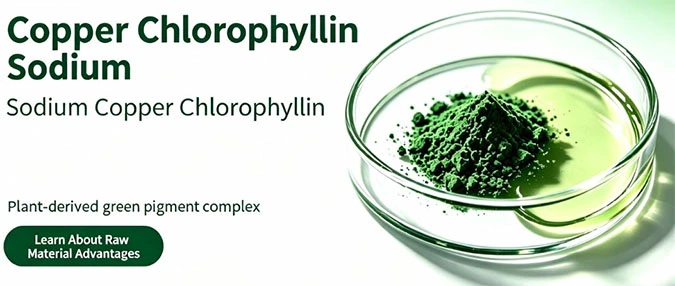
| Appearance | Dark green to blackish-green fine powder |
| CAS Number | 11006-34-1 |
| Molecular Formula | C₃₄H₃₁CuN₄Na₃O₆ |
| Molecular Weight | 724.15 |
| Extraction Type | Solid Extraction |
| Particle Size | 100% Pass 80 Mesh |
| Copper Content | 4.0%–6.0% |
| pH Value (1% Solution) | 9.0–11.0 |
| Loss on Drying | ≤5.0% |
| Solubility | Water soluble |
| Grades Available | Food Grade (E141ii), Cosmetic Grade, Pharmaceutical Grade |
| MOQ | 1kg |
| Storage | Store in tightly closed original container, protected from light |
| Sample | Available for testing |
| Certifications | FDA, ISO9001, HACCP, HALAL, Kosher |
Quality Assurance
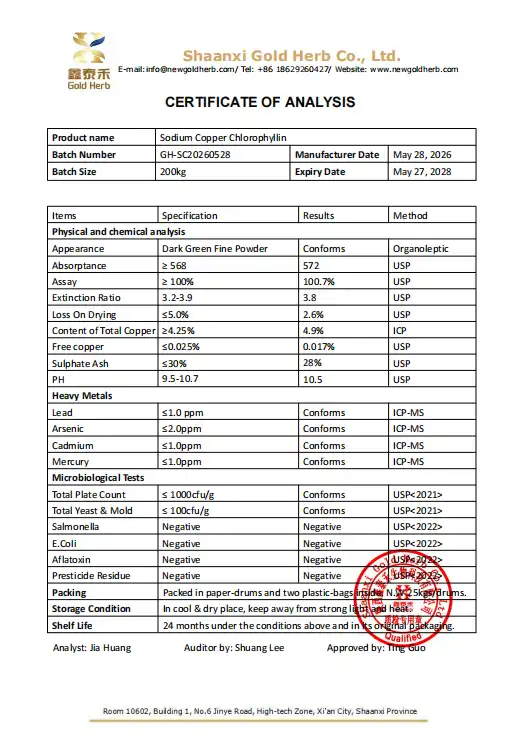
Certificate of Analysis (COA) for Sodium Copper Chlorophyllin Powder [Request COA]
Understanding Sodium Copper Chlorophyllin Powder
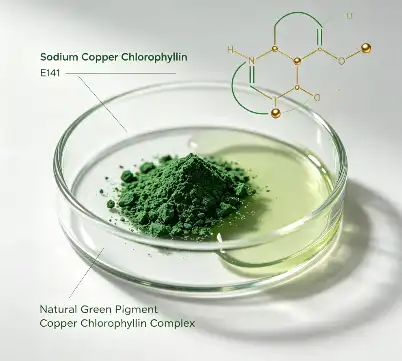
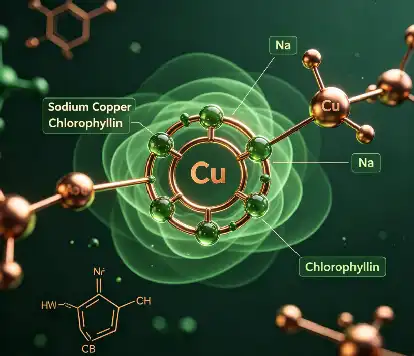
Naturally occurring chlorophyll, which is often extracted from the leaves of mulberry or lucerne plants, is saponified in order to produce sodium copper chlorophyllin, a chemical that is considered to be semi-synthetic. Copper is substituted for the magnesium atom that is located in the center of the structure during this process, which results in the structure being much more stable. One of the most significant issues with natural chlorophyll, which is addressed by this modification, is that it degrades rapidly when it is subjected to circumstances that are reactive, such as light or heat. There is a dark green to blackish-green colour to the fine powder that is produced (the CAS number for this substance is 11006-34-1). It provides manufacturers with a robust solution that maintains the color's vibrancy throughout the manufacturing and storage processes.
Key Differences from Natural Chlorophyll
This copper-stabilized chlorophyll does not oxidise and become brown as oil-soluble chlorophyll does; it is able to dissolve readily in water and can withstand being heated. When it comes to industrial procedures that entail baking, pasteurisation, or the production of sweets at high temperatures, this thermal robustness is quite advantageous. Copper chelation prevents magnesium-based chlorophyll from degrading in light, which enables items to maintain their attractive green colour even after being exposed to light for an extended period of time while they are being shown.
Primary Industrial Applications
There is more than one use for the component in a variety of contexts. In its capacity as a natural colourant (E141ii), it imparts vibrant green hues to beverages, confections, baked goods, and dairy products without causing the instability that is associated with plant-based alternatives. It is not only appealing to the eye, but it also contributes to the reduction of body odour by binding to other compounds that are present in food items. Research indicates that antioxidants have positive effects on health, which is something that firms that manufacture functional foods are searching for in clean-label ingredients. Not only is the chemical used in the treatment of wounds in the medical field, but it is also utilised in animal feed due to the fact that its bioactive properties contribute to the overall health of the animal.
Safety Profile and Regulatory Status
Regulatory thresholds and dosage criteria are very important pieces of information for manufacturers to be aware of. International standards, such as those established by JECFA and USP, place very stringent restrictions on the quantity of free copper that may be present in order to ensure the safety of individuals. Stable chelation, which prevents copper ions from escaping throughout the formulation process, is something that reliable providers guarantee. Customers from all around the globe are able to purchase the ingredient since it has been granted approval by the Food and Drug Administration (FDA) and satisfies the standards for ISO9001, HACCP, HALAL, and Kosher certification. With the help of this comprehensive compliance framework, manufacturers are able to introduce the ingredient to regulated product categories in a risk-free manner while successfully satisfying the requirements of customers who need clean labelling.
How to Choose the Right Bulk Sodium Copper Chlorophyllin Powder Supplier
In the process of selecting a provider, it is not sufficient to just compare rates; you must also take into consideration the technical capabilities, quality systems, and operational reliability of the potential provider. There is more than simply the cost of the ingredients that is impacted by the connection. In addition, it has an impact on the reliability of the production, the adherence to the regulations, and the achievements of the company over the long term. Manufacturers have to use the same level of caution when selecting a supplier as they do when making other significant choices pertaining to their businesses.
Quality Certifications and Compliance
Audits conducted by third parties are an effective method for ensuring that potential service providers maintain their ISO9001, GMP, and HACCP certifications at the most recent levels. Your possession of these qualifications demonstrates that you are capable of managing quality and control procedures in a methodical manner. You should request evidence that the business is registered with the FDA as well as results from third-party testing that provide confirmation that it satisfies regional criteria. A Certificate of Analysis (CoA) should be provided by the suppliers for each batch. This document should include a listing of the levels of purity, the quantity of copper that is present, and the results of any microbiological testing. When it comes to traceability, the documentation must travel all the way back to the first place where the raw materials were obtained. This ensures that there is transparency across the whole supply chain.
Technical Support and Customization Capabilities
Leading suppliers of Sodium Copper Chlorophyllin Powder don't just sell generic ingredients; they also help with formulation and give technical advice. Check to see if the supplier has technical staff with a lot of experience who understand the problems you're having with your application. Gold Herb works with some of the best research institutions, like Academician Li Xiaokun's team and Wenzhou University. This gives us a lot of experience screening ingredients and proving that products work. With this science support, we can give you the best advice for your recipe needs, whether you're making acidic drinks that need suspension stabilizers or sweets that need to be as thermally stable as possible.
Logistics and Supply Chain Reliability
For bulk purchases to work, the logistics system needs to be strong. Check the supplier's inventory management system to see if they keep enough stock to meet urgent orders. Gold Herb keeps more than a ton of standard items in stock, so they can ship orders 24 hours after they are confirmed. Our warehouses in the U.S. guarantee delivery within 3–5 business days within the U.S. This gets rid of the need for long wait times that can mess up production plans. We work with DHL, SF Express, and FedEx to make sure that international shipping is reliable and that all the paperwork needed for customs clearance goes smoothly.
Performance History and Customer References
Get case studies or examples from makers in the same line of work as you. A supplier's history with similar projects can tell you a lot about how reliable they are. We're proud to have over 200 happy customers in 30 or more countries, including companies that make cosmetics, nutritional supplement brands, food processors, and drug companies. Our ability to meet different technical needs and regulatory standards in many different jurisdictions is shown by the wide range of clients we have.
Bulk Purchase Considerations: Pricing, MOQ, and Logistics
Budgeting and planning the supply chain are easier when you know about the economic and practical parts of buying in bulk. Different pricing structures are based on a number of factors that manufacturers should carefully consider.
Pricing Variables and Market Benchmarks
The price per kilogram changes depending on the amount of quality. Pharmaceutical-grade varieties are more expensive than food-grade varieties. The amount of an order has a big effect on the price per unit; sales over 500 kg usually qualify for tiered savings. Prices on the market also depend on the abundance of raw materials. For example, harvest cycles affect the supply of chlorophyll from hay. Manufacturers should get quotes from several sources to get a good idea of what prices are generally like. This will help them negotiate better and plan their budgets better.
Minimum Order Quantities and Flexibility
A lot of suppliers have minimum order quantities that are between 25 kg and 100 kg, which could be hard for smaller manufacturers or those trying out new formulas. Because we know that innovation needs to be flexible, our OEM arrangements let us offer custom order sizes. This way of doing things works for trial production runs without making people commit to too much inventory. Custom orders are usually finished in 7–15 business days, but when production needs to be finished quickly, our emergency "green channel" service can deliver small batches in 5–7 days.
Storage and Handling Requirements
Keeping ingredients in the right way will keep their quality throughout their shelf life. To keep the substance from photo-oxidation and color strength loss over time, it needs to be kept out of direct sunlight. Keep things in their original, tightly closed cases that won't let light in. Keep them in cool, dry places. Moisture getting into a material can cause it to clump and move less easily, which makes dosing more difficult during production. Set up controlled storage areas that can be monitored for temperature and use first-in, first-out inventory rotation to keep things fresh. These protocols keep the bright green color and useful properties of the ingredient that support its value proposition.
Comparing Different Forms and Types of Sodium Copper Chlorophyllin Powder
Manufacturers have to make choices about the form of Sodium Copper Chlorophyllin Powder products, how to prove their origin, and how to evaluate different ingredients. Each choice has an effect on how well the recipe works and how much it costs.
Powder vs. Liquid Formulations
Powder is still the most common form because it is more stable and cheaper to ship. Compared to liquid concentrates, which carry a lot of water, it has a longer shelf life, doesn't need to be preserved, and costs less to ship. In continuous production systems with automated dosing, liquid forms are easier to use because they require fewer steps of handling. This choice should be based on how you make things. For example, powder is better for batch production with manual weighing, while investments in infrastructure for handling liquids may be worth it for high-volume continuous operations.
pH Stability Considerations
When making acidic goods, formulation makers have to think about how sensitive people are to pH. The element works best in settings that are neutral to slightly acidic. Below pH 6, there is a greater chance of precipitation, which could lead to color differences or sedimentation during storage. To keep the suspension in acidic delivery formats, beverage makers often use hydrocolloids or stabilizing systems. Testing recipe samples under rapid aging conditions finds possible stability issues before the product goes on sale. This keeps the product from having to be reformulated after it hits the market, which would be expensive.
Natural vs. Synthetic Sourcing
More and more, consumers want ingredients that come from nature and are certified organic. All sodium copper chlorophyllin on the market goes through semi-synthetic changes when copper is replaced, but the source of the chlorophyll that was used for the first time is important for clean-label labeling. If you're trying to reach people who like natural products, make sure that the plants your sellers use come from approved organic sources. Even though chemicals were changed during production, this authentication backs up marketing claims and meets retailer needs for natural product categories.
Ensuring Quality and Compliance in Bulk Sodium Copper Chlorophyllin Powder Procurement
To keep the quality of a product consistent, suppliers must work together and follow systematic quality assurance protocols. Following the rules ensures the safety of consumers and the image of the brand.
Incoming Material Inspection Protocols
Set up strict receiving processes that check the name and quality of materials before they are used in production. Visually check to make sure the dark green color is there and there are no other colors or foreign objects. Check important factors like the amount of moisture, the distribution of particle sizes, and the copper content against the limits given. Microbiological tests should make sure that there are no pathogens and that the total plate count levels are met. Keep some samples from each lot you get so that you can do traceability checks if there are quality problems later on.
Batch-to-Batch Consistency Verification
Changes in color strength between runs make it hard to make consistent formulations, which require recipe changes that make manufacturing more difficult. Suppliers should show statistical process control data that shows tight ranges of specifications for each production lot. Ask for historical CoA data that covers more than one month to look for patterns of variation. We do full quality control on our solid extraction process, from choosing the raw materials to the final packing. This makes sure that the stability between batches is maintained, which is important for large-scale production.
Documentation and Traceability
A lot of paperwork helps with legal audits and lets people respond quickly to quality reviews. When products need these credentials, suppliers must show certificates that prove they are HALAL, Kosher, or organic. Phytosanitary certificates and proof of country of origin make it easier for international shipments to get through customs. Labeling rules all over the world are met by allergen statements and GMO status announcements. We keep full records that connect the locations where raw materials were harvested to the locations where finished goods were made. This gives manufacturers who care about quality the openness they need.
Conclusion
To find bulk Sodium Copper Chlorophyllin Powder, you have to balance technical requirements with the supplier's skills and practical logistics. Partners who have quality certifications, technical know-how, flexible order terms, and reliable supply chain execution are good for manufacturers. The ingredient is becoming more popular in the food, supplement, cosmetic, and pharmaceutical industries because it is stable, can be used for more than one thing, and is good for the environment. By carefully choosing suppliers and following strict quality control procedures, manufacturers can use this natural colorant in a variety of ways while still meeting legal requirements and customer standards for product quality and transparency.
Frequently Asked Questions About Sodium Copper Chlorophyllin Powder
1. What distinguishes this ingredient from standard chlorophyll?
Standard chlorophyll dissolves in oil and breaks down quickly in light and heat, turning brown within days. Sodium copper chlorophyllin swaps out the magnesium center for copper and adds sodium salts, making a compound that dissolves in water and is very stable in both heat and light. This change makes it possible for commercial use in water-based formulations that need to have a longer shelf life.
2. Can it function in acidic beverage applications?
The compound is stable in pH ranges from neutral to alkaline, but it may form crystals in acidic environments below pH 6. To keep colors in suspension in acidic systems, beverage formulators often use stabilizers or hydrocolloids. Unexpected precipitation problems can be avoided by testing the stability in the storage conditions that will be used before the business starts.
3. What storage conditions preserve ingredient quality?
The combination is still photosensitive, even though it is more stable than real chlorophyll. Store in cool, dry places that don't let light in and don't let air in. Light slowly changes colors by photo-oxidation, which weakens colors over time. If you store the ingredient properly, it will keep its bright green color and useful properties for a long time.
Partner With Gold Herb for Premium Sodium Copper Chlorophyllin Powder Supply
Gold Herb can help you get the Sodium Copper Chlorophyllin Powder in bulk that you need. They offer approved, high-quality powder and full expert support. Our FDA, ISO9001, HACCP, HALAL, and Kosher licenses make sure that we follow the rules in all global markets. Plus, our partnerships with top research institutions give us the scientific knowledge to help you make great formulations. We know what it takes to run a large-scale manufacturing business because we have been a supplier of Sodium Copper Chlorophyllin Powder for many years and have over 200 customers in 30+ countries. We offer solutions that can be changed to fit your business needs. These solutions can include specs, packaging formats, and shipping times. Our U.S. warehouses allow us to quickly fulfill orders within the United States, and our many global logistics partnerships ensure that international shipping is always on time. Whether you need standard specifications from our permanent inventory or OEM development that is made just for you, our team is here to help you every step of the way during the procurement process. Email us at info@newgoldherb.com to get samples, talk about your technical needs, and get competitive bulk pricing quotes that fit your budget and schedule.
References
1. Egner, P.A. et al. "Chlorophyllin Intervention Reduces Aflatoxin-DNA Adducts in Individuals at High Risk for Liver Cancer." Proceedings of the National Academy of Sciences, 2001.
2. Ferruzzi, M.G., and Blakeslee, J. "Digestion, Absorption, and Cancer Preventative Activity of Dietary Chlorophyll Derivatives." Nutrition Research, 2007.
3. Kumar, S.S., et al. "Chemistry and Biological Activities of Chlorophylls and Their Derivatives." Mini-Reviews in Medicinal Chemistry, 2004.
4. Tumolo, T., and Lanfer-Marquez, U.M. "Copper Chlorophyllin: A Food Colorant with Bioactive Properties?" Food Research International, 2012.
5. Joint FAO/WHO Expert Committee on Food Additives. "Evaluation of Certain Food Additives: Sodium Copper Chlorophyllin." WHO Technical Report Series, 2008.
6. Breinholt, V. et al. "Dietary Chlorophyllin is a Potent Inhibitor of Aflatoxin B1 Hepatocarcinogenesis in Rainbow Trout." Cancer Research, 1995.

Send Inquiry
Related Industry Knowledge
- Resveratrol Powder Manufacturing Process and Purity Testing Guide
- How to Choose a Reliable Dihydromyricetin Supplier
- Ergothioneine Supplement Guide: Facts, Benefits, and Usage
- Premium Urolithin A Manufacturer and Bulk Supplier
- Urolithin A vs NMN: What's the Difference?
- Fisetin: Benefits, Dosage, and Safety Guide
- Sodium Copper Chlorophyllin Benefits for Skin, Detox & Health
- Ergothioneine Powder: A Premium Antioxidant for Cellular Protection and Anti-Aging Solutions
- Natural 5-Hydroxytryptophan (5-HTP) Powder Supplier for Functional Nutrition Products
- What are the 4 benefits of Lotus Leaf Extract?