
How to Choose Matcha Powder for Food and Beverage Products
Sep 08, 2026
Choosing the right matcha powder for food and beverage applications starts with understanding what separates a functional-grade ingredient from a commodity powder. True matcha derives from shade-grown Camellia sinensis leaves stone-milled at low temperatures, preserving bioactive catechins like EGCG, L-theanine, and chlorophyll. For B2B buyers—whether you're formulating RTD beverages, bakery products, or dietary supplements—the grade, origin, purity, and supplier certification all determine whether your finished product meets both regulatory standards and consumer expectations. Getting this decision right early protects your formulation investment and supply chain integrity.
Matcha Powder Specifications
|
Item |
Specification |
|
Product Name |
Matcha Powder |
|
Botanical Source |
Camellia sinensis |
|
Plant Part |
Tea Leaves |
|
Appearance |
Green Fine Powder |
|
Color |
Green to Bright Green |
|
Particle Size |
Customizable |
|
Main Components |
Tea Polyphenols, Catechins, Caffeine, L-Theanine, Chlorophyll |
|
Solubility |
Dispersible in Water |
|
Test Method |
According to Product Specification |
|
Shelf Life |
24 Months |
|
Storage |
Cool, Dry and Protected from Light |
Understanding Matcha Powder and Its Importance in Food & Beverage
Why Has Matcha Become a Strategic Functional Ingredient?
If you look at Grand View Research, the global market for matcha powder will be worth about USD 3.5 billion by 2030. It is expected to grow at a CAGR of over 8% until then. This growth shows a real change in how people buy things—they are actively looking for natural, useful ingredients that can be traced back to their source and have health effects that can be measured.
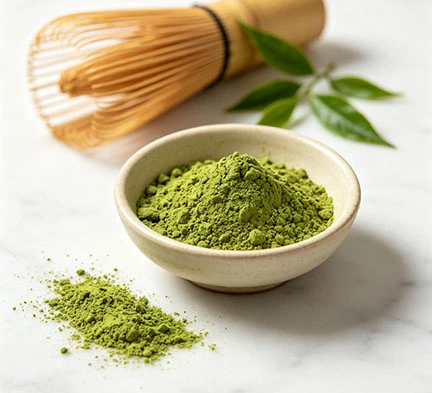
The way that real matcha is grown is what makes it different from regular green tea powder. Higher levels of chlorophyll and L-theanine are made when tea plants are shaded for 20 to 30 days before they are picked. The leaf that is made, tencha, is then stone-milled at low temperatures to make a fine powder that is very water-soluble and still has all of its volatile aromatics. This process can't be done with normal grinding tools, which is why origin verification is so important in business-to-business sourcing.
Color-changing plants like Blue Matcha Butterfly Pea Flower Powder are now part of the functional beverage market, along with green tea. This purple-blue powder is 99% pure and has a unique anthocyanin-driven color-shifting property that makes it turn purple or pink when exposed to acid. This makes it an appealing, caffeine-free option for brands that want to stand out visually while also getting antioxidant benefits.
Core Criteria to Consider When Selecting Matcha Powder for Your Products
Grading, Sensory Attributes, and Certification
Not every grade of matcha powder can be used for every task. When first-flush leaves are picked in early spring for ceremonial grade, they have a higher ratio of amino acids to catechins, which makes the flavor smooth and umami-forward. For culinary grade, on the other hand, later crops with higher catechin levels and stronger astringency are used. This is done so that the taste can stand out in high-fat or high-sugar foods like baked goods and ice cream.
Before making a decision about a provider, every buying team should look at these key quality indicators:
- Color brightness: Real, high-quality matcha has a bright, deep green color. If olive tones turn yellow or dull, it means that the oil has been oxidized, broken down after harvesting, or mixed with lower-quality oils. This is a good way to tell if the oil is of good quality.
- Particle size: Milled to 2–20 microns for real matcha. Coarser particles mean the grinding wasn't done right, which leads to uneven dispersion and sedimentation in liquid matrices, which is a major failure point for RTD beverage formulations.
- Organic and food safety certification: You must have USDA Organic, FDA compliance, and HACCP documentation in order to enter the U.S. market for matcha powder. ISO 9001 shows that quality management is used throughout the whole production process.
- Heavy metal compliance: Reliable providers test soil and products with ICP-MS to make sure that amounts of lead, cadmium, and arsenic are within international limits. This is necessary for exporting to other countries.
These factors together tell you if an ingredient in green tea powder will work regularly throughout your production processes. If you skip any of them, you create formulation and regulatory risk further down the line that is hard to fix and costs a lot of money.
Origin and Authenticity Verification
As part of their due diligence, many buyers ask for traceable geographic identifiers on real Japanese matcha from places like Uji, Nishio, or Kagoshima. Third-party HPLC chromatographic analysis from suppliers can confirm that the amino acid profiles and catechin ratios match the claimed grade and harvest season. This is an open practice that boosts trust in sourcing.
Matching Procurement Needs to Matcha Powder Solutions
Aligning Grade Selection to Your Product Category
The placement of the end product should be directly linked to the procurement plan. If you want to make a high-end functional drink for health-conscious people in the U.S. market, you need ceremonial or first-grade gourmet matcha powder, which has a lot of flavor and L-theanine to back up your claims. Standard cooking grade can be used in a mass-market baked goods line without lowering the amount of EGCG or antioxidants, though.
Standardization is very important for companies that make nutraceuticals and dietary supplements. When used in capsules or functional powder mixes, matcha has to be very homogeneous, have a controlled bulk density, and have a known EGCG content for each batch. Label claim truth and regulatory compliance are directly affected by these inconsistencies.
You should also think about adding matching herbs. Brands that want to make visually appealing, clean-label drinks can use Clitoria ternatea L.'s Blue Matcha Butterfly Pea Flower Powder as a unique option. It dissolves easily in water, stays stable at high temperatures and in alcoholic settings, and has certifications from FDA, ISO 9001, HACCP, HALAL, and Kosher. This makes it easy to add to functional drinks, flavored waters, and party mixers. It also supports antioxidant claims because it has a lot of anthocyanins but not a lot of caffeine, which is a clean-label benefit that fits well with current U.S. customer trends.
If you match the right powder to the right application from the start, you can avoid expensive reformulation rounds and get your product to market faster.
Best Practices for Evaluating and Storing Matcha Powder in a B2B Context
Quality Control Protocols Upon Receipt
A systematic intake inspection is done on every batch of matcha powder or botanical extract that comes in to protect the integrity of your formulation. Checking the level of wetness, the smell, and the regularity of the appearance gives you a quick starting point. If there is a difference from the accepted sample standard, the batch should be held and tested again before it goes into production.
Certifications only tell part of the story; third-party reports with analysis fill in the rest. Ask for COA papers that show the percentage of moisture, mesh size, microbial counts, heavy metal levels, and pesticide residue data. Suppliers who give these out of the blue, rather than just when asked, show more quality transparency.
Storage Conditions That Preserve Bioactivity
Oxygen, light, moisture, and heat can all damage matcha powder very quickly. The best way to store things in the industry is in multi-layer, nitrogen-flushed, opaque metal foil containers that are kept below 15°C. A standard shelf life of 12 to 18 months is possible if the right conditions are met. Testing for peroxide value keeps an eye on lipid oxidation from plant cell wall pieces and is a reliable way to check the quality of food throughout its shelf life. To keep the anthocyanin stability, butterfly pea flower powder also needs to be kept in its original, tightly sealed container that is kept out of the light.
Making the Final Decision: How to Choose the Right Matcha Powder Supplier?
Evaluating Supply Chain Reliability and Technical Support
When looking for a seller of matcha powder, price is rarely the best way to start. Operational reliability is the most important part of the evaluation process. This includes quality that stays the same from batch to batch, quick technical support, flexible minimum order quantities, and proven logistics capabilities.
A good supplier will always have documented traceability from the source of the raw materials to the testing of the finished product, as well as multi-certification compliance for FDA, ISO 9001, HACCP, HALAL, and Kosher, and the ability to support OEM or customized specifications as your product pipeline changes.
This standard is shown by Shaanxi Gold Herb. With more than three years of professional experience making plant extracts and more than 200 customers in more than 30 countries, Gold Herb keeps more than a ton of standard specs in stock so that orders can be sent out the same day or within 24 hours of being confirmed. U.S. warehouse stock makes fulfillment possible in 3–5 business days, which directly cuts down on supply chain delays for American buyers. Its research and development infrastructure is based on a strategic partnership with Ancooin Biotechnology and the technical resources of Academician Li Xiaokun's team at Wenzhou University. This gives the company formulation and effectiveness validation support that not many ingredient suppliers can match.
Conclusion
Choosing the right matcha powder for making food and drinks is a complex choice that should be made after careful consideration. Long-term product success depends on grades that are aligned with applications, strict certification checks, stable storage practices, and a supplier that has a history of operating reliability. The rules for quality sourcing stay the same whether you're looking for traditional green tea extracts or new color-active botanicals like butterfly pea flower powder. Your final product will show that you are serious about your procurement process if it is based on proof, openness, and professional partnership.
FAQ
1. What is the key difference between ceremonial and culinary grade matcha powder?
Ceremonial grade comes from first-flush spring harvests and has a higher amino acid-to-catechin ratio. It has a smooth, sweet taste that goes well with high-end drinks without hiding the ingredients. The culinary grade comes from later crops that are tastier and have more catechins. This makes it perfect for baking, ice cream, and supplement mixes where different flavors need to work together. HPLC chromatographic research is a scientific way to prove these differences in makeup for each matcha powder batch.
2. How can I verify the authenticity of matcha powder from suppliers?
Ask for third-party COA documents that show HPLC profiles of amino acids and catechins, as well as proof of the product's country of origin and pesticide residue test results. Suppliers who offer tracked soil origin records and heavy metal ICP-MS testing before shipping show that they are serious about being open and honest. Performing your own incoming inspection against a reference sample that has been approved adds another level of verification.
3. What factors most impact matcha powder shelf life during storage?
Oxygen, UV light, high humidity, and temperatures above 15°C are the main things that break down materials. Nitrogen-flushed, opaque aluminum foil packaging makes food last a lot longer. Testing the peroxide value on a regular basis keeps an eye on the oxidative integrity. When you store butterfly pea flower powder in a jar that is tightly covered and keeps light out, the anthocyanin stays stable for about the same amount of time.
Partner with Gold Herb—Your Trusted Matcha Powder Supplier
Gold Herb ships high-quality plant-based ingredients, like Blue Matcha Butterfly Pea Flower Powder, which is 99% pure and certified by FDA, ISO 9001, HACCP, Halal, and Kosher. Orders for premium matcha powder are filled in the U.S. warehouse and delivered in 3–5 business days. You can get free samples, OEM help, and specs that are made just for you. To get your sample right away, email our team at info@newgoldherb.com.
References
1. Grand View Research. Matcha Tea Market Size, Share & Trends Analysis Report. 2023.
2. Food Chemistry. Catechin and Amino Acid Profiling of Shade-Grown Green Tea (Camellia sinensis). Elsevier, 2021.
3. Journal of Agricultural and Food Chemistry. Anthocyanin Stability and Color Expression in Clitoria ternatea Extracts Under Variable pH Conditions. ACS Publications, 2020.
4. Comprehensive Reviews in Food Science and Food Safety. Functional Ingredients in Fortified Beverages: Stability and Bioavailability Considerations. IFT/Wiley, 2022.
5. Food Quality and Preference. Consumer Perception of Natural Colorants and Clean-Label Formulations in Functional Beverages. Elsevier, 2022.
6. Critical Reviews in Food Science and Nutrition. EGCG Bioavailability and Health Effects of Matcha versus Conventional Green Tea. Taylor & Francis, 2021.

Send Inquiry
Related Industry Knowledge
- Blue spirulina extract Nutrition: What Does It Contain?
- Top 10 Natural Healthy Aging Ingredients for Longevity Supplement Formulations
- NAD vs NMN: Which Actually Works Better for Aging?
- Kava Extract vs Valerian extract Benefits Compared
- Is Centella asiatica extract the same as gotu kola?
- What Is Coleus forskohlii extract and How Does It Work?
- What Is Fenugreek? Here Are Its 7 Potential Health Benefits
- 5-Hydroxytryptophan Benefits for Sleep, Mood, and Stress Relief
- Where to Buy Pharmaceutical-Grade Gymnema Sylvestre Extract Powder?
- Sodium Copper Chlorophyllin Powder for Cosmetic Formulations