
What is Berberine HCl 97% used for?
Jul 23, 2026
Berberine HCL 97% is a standardized botanical extract obtained from Coptis chinensis or Berberis aristata. It is used as a raw material in dietary supplements, nutraceuticals, and functional food formulations where a 97% berberine hydrochloride specification is required.
Gold Herb supplies Berberine HCL 97% in bulk with complete product documentation, including COA (Certificate of Analysis), Laboratory Reports, and technical specifications. Samples are available for formulation testing and supplier evaluation before bulk orders. Our Technical Support team can assist with product specifications, documentation, packaging options, and sourcing inquiries. For quotations or sample requests, please contact info@newgoldherb.com.
Product Specifications
| Parameter | Specification |
|---|---|
| Product Name | 97% Berberine HCL Powder |
| Appearance | Yellow Powder |
| Assay | ≥97% Berberine HCl |
| CAS Number | 633-65-8 |
| Formula | C20H18ClNO4·2H2O |
| Molecular Weight | 407.85 |
| Test Method | HPLC, UV |
| Loss on Drying | ≤12.0% |
| Residue on Ignition | ≤0.2% |
| Particle Size | 100% pass 80 mesh |
| Solubility | Soluble in water and ethanol |
| Storage | Store in tightly closed container, protected from light |
| Certifications | FDA, ISO9001, HACCP, HALAL, Kosher |
Quality Assurance
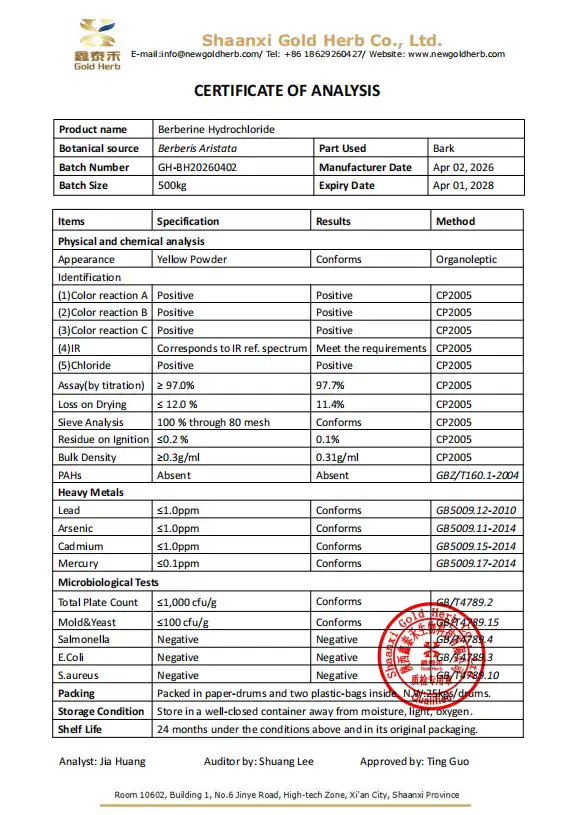
Certificate of Analysis (COA) for Berberine HCl 97% Powder [Request COA]
Understanding Berberine HCL 97% and Its Core UsesWhat Makes Berberine HCL 97% a Premium Ingredient?
Plant-based Berberine Hydrochloride is quality-controlled. 97% pure. This specification excludes Palmatine and Jatrorrhizine, which may affect clinical findings, compared to lower-grade rivals. Hydrochloride dissolves better than sulfate, making it easier to absorb and use in supplements. This yellow ethanol-water-extracted crystalline powder was examined by HPLC. Sealing and lightproofing containers work.
Its chemical stability and efficacy make it crucial in many circumstances. For functional drinks, capsules, and tablets, manufacturers like its flexibility. Microencapsulation or cyclodextrin complexing agents may mask its harsh taste in consumer items as an indication of authenticity.
Primary Applications in Health and Nutrition
Blood sugar management is most researched. That chemical activates AMPK, a cell energy sensor that regulates glucose intake and insulin sensitivity. Clinical trials demonstrate it lowers increasing blood glucose and hemoglobin A1C. For metabolic health products for diabetics at risk, this is useful.
This alkaloid changes lipid processing and prevents fat accumulation, making it common in weight reduction solutions. It influences adipocyte development and brown adipose tissue function, according to research. Because it targets glucose and lipid pathways, it's used in metabolic support supplements.
It controls cholesterol for cardiovascular health. Triglycerides and LDL cholesterol drop, but HDL levels remain high, according to research. Our multi-target strategy matches customer demand for natural alternatives to synthetic statins, which heart health firms prefer.
Research on gut health is new. Digestion goods benefit from the compound's gut flora-changing and pathogenic-bacteria-fighting properties. It improves gut barrier function, expanding formulation possibilities.
Why Procurement Teams Choose 97% Purity?
Significant production issues are solved with 97% standardization. Batch-to-batch uniformity eliminates crude extract issues. This lets R&D teams create models that always work, speeding up product production and lowering reformulation costs.
Following guidelines is easy with pharmaceutical-safe materials. To satisfy North American and Middle Eastern consumers, Gold Herb's Berberine HCL 97% powder is FDA, ISO9001, HACCP, HALAL, and Kosher certified. Heavy metal testing indicates that Lead (<3.0ppm), Arsenic (<1.0ppm), Mercury (<0.1ppm), and Cadmium (<1.0ppm) levels are below Proposition 65 and EU specifications.

How Does Berberine HCL 97% Work? Mechanism of Action Explained
Cellular Energy Regulation Through AMPK Activation
AMPK activation is the compound's major effect. Berberine disables mitochondrial complex I in cells. This reduces cell energy, activating AMPK. Glucose transporter (GLUT4) moves to cell membranes via this metabolic master switch. This improves glucose uptake without insulin. Insulin-resistant patients benefit most from this insulin-mimetic action.
AMPK activation arrests hepatic gluconeogenesis, the liver's glucose production. Increasing peripheral glucose absorption and reducing hepatic glucose output regulate blood sugar completely. Fasting plasma glucose can drop 15-20% in 12 weeks, similar to pharmacological therapies, according to clinical research.
Lipid Metabolism and Cardiovascular Protection
Lipids are regulated in numerous ways. Turning on AMPK inhibits acetyl-CoA carboxylase. Fatty acid synthesis slows and burning accelerates. The chemical stimulates LDL receptor expression in hepatocytes, speeding LDL cholesterol clearance from the circulation. In meta-analyses of over 2,000 patients, LDL cholesterol drops by 20–25 mg/dL and triglycerides by 35–40 mg/dL.
Cardioprotection improves endothelial function. Berberine boosts vascular endothelium nitric oxide production, widening blood channels and improving blood flow. Over time, this mechanism and its anti-inflammatory properties may reduce arterial stiffness and maintain vascular health.
Safety Profile and Dosage Considerations
Thousand-person clinical safety data indicates the drug's minimal risk profile at the correct dosages. Most regimens recommend 500 mg with meals two to three times a day, totaling 1,000 to 1,500 mg. Divided doses enhance absorption and reduce stomach discomfort, the most prevalent adverse effect. To achieve plasma concentrations, larger doses are needed because the drug has 5% bioavailability when taken orally.
Cytochrome P450 enzyme-degrading drugs may interact with this medication. Pharmaceutical formulators must provide proper labeling for prescription medications. Given the lack of safety evidence on pregnant and nursing women, these should be considered.
Comparing Berberine HCL 97% with Other Berberine Variants
Purity Grades and Performance Implications
There are berberine products on the market that range in quality from 90% to 99%. Each one is good for a different purpose. The 95% grade is a good value for money for mass-market supplements where price is the main factor in decision-making. But the 5% impurity fraction might have related alkaloids that make clinical outcomes less consistent and make quality documentation harder.
The 98% specification is appealing to high-end brands that focus on making formulations that are very pure. Even though the small rise in purity above 97% doesn't really help with therapy, the 10-15% price premium is sometimes worth it for business reasons. Manufacturers who want to make products for medical use may choose this level to meet study standards that require 98% purity.
This high-purity grade is the best mix of purity, value for money, and dependability in performance. At Gold Herb, our Berberine HCL 97% powder is checked using HPLC against primary reference standards to make sure that the assay threshold is always met. Cross-reactivity problems that hurt the supplement's effectiveness are avoided by the managed impurity profile, which has very little Palmatine and Jatrorrhizine.
Powder vs. Encapsulated Forms
Buying powder in bulk gives manufacturers the most options for how they make things. To make metabolic support matrices that work better, formulators can mix berberine with ingredients that work well together, such as alpha-lipoic acid, chromium picolinate, or cinnamon extract. The powder form works with a range of encapsulation technologies, from simple gelatin capsules to more advanced delayed-release systems that improve absorption in the intestines.
Pre-encapsulated goods make dealing easier, but they limit the ways you can customize them. Private label partners may like this style because it lets them get into the market quickly. In exchange for shorter production times, they may be willing to accept standard dosage amounts. The trade-off is higher costs per unit and less room to stand out in supplement areas that are already very crowded.
Berberine vs. Pharmaceutical Alternatives
It and metformin reduce blood sugar similarly; hence, they are commonly compared. Although Metformin has been shown to be beneficial in clinical studies for decades, Berberine is superior at regulating lipids and doesn't cause vitamin B12 loss. People seeking natural alternatives choose berberine. This opens markets for products that combine botanical expertise with contemporary science.
In combination tactics, new trends emerge. Berberine and Trimethylglycine (TMG) influence glucose and homocysteine breakdown. Some add omega-3 fatty acids or fat-soluble vitamins to treat several cardiovascular risk factors. Multi-ingredient approaches need vendors that can aid with technical challenges when formulation, testing, and reporting to regulators.

Procurement and Sourcing – Buying Berberine HCL 97% with Confidence
Critical Quality Certifications and Standards
Successful buying begins with supplier identification. ISO9001 accreditation demonstrates planned quality management, while HACCP compliance shows safe production. FDA clearance ensures manufacturers obey U.S. laws, which is crucial for businesses selling to Americans.
Businesses reach more people with religious food licenses. Kosher clearance is for North American and European organizations, whereas HALAL certification opens Middle Eastern and Southeast Asian markets. Gold Herb maintains FDA, ISO9001, HACCP, HALAL, and Kosher certifications. This eliminates the need for several vendors for each market group.
Evaluating Analytical Testing Protocols
Analysis distinguishes premium vendors from basic ones. The HPLC test shows that berberine must be 97%, preventing the addition of cheaper alkaloids for economic reasons. GC analysis detects any leftover solvents, ensuring that ethanol stays below 5,000ppm and Class 1 solvents like benzene are absent.
ICP-MS heavy metal screening accurately measures hazardous elements. Microbiological tests reveal no E. coli and a Total Plate Count of fewer than 1,000 CFU/g. E. coli and Salmonella, preventing costly product recalls.
C14 radiocarbon dating verifies the source and distinguishes plant extracts from manufactured ones. This assurance is crucial for "clean label" firms whose reputation rests on natural ingredient claims. High-fidelity HPLC fingerprinting shows the unique minor impurity profile of botanical sources, adding another degree of verification.
Supply Chain Reliability and Lead Times
Good inventory management affects your manufacturing schedule. Gold Herb ships orders within 24 hours of confirmation since it has over a ton of standard specifications. This prevents manufacturing delays, which reduce profitability and customer satisfaction.
Work on customisation requests takes longer. Custom requirements can be changed in particle size, secret mix compositions, or packaging within 7–15 business days. Emergency orders can go through our speedy "green channel," which delivers small batches in 5–7 days.
Packages arrive safely and on schedule thanks to DHL, FedEx, and SF Express global delivery arrangements. North American orders are fulfilled in three to five business days due to our continual inventory in the U.S. warehouse. Consolidated freight management reduces international shipping delays and landing costs.
Best Practices for Using Berberine HCL 97% in Product Development
Dosage Optimization and Formulation Strategies
The most reliable way to take this drug is three times a day, at 500 mg each time. This plan, which includes taking 1,500 mg every day, is in line with most published studies that show benefits for sugars and lipids. Formulators of twice-daily products may choose 750mg doses, even though this goes against established clinical guidelines and could make people less confident in the product's effectiveness.
Increasing bioavailability is the next big thing in formulation. P-glycoprotein efflux pumps actively move the molecule back into the gut lumen, which is why berberine is not well absorbed by the intestines. Piperine (black pepper extract), which blocks P-glycoprotein, is one example of an ingredient that might help absorption. However, this method needs to be carefully tested in the clinic because blocking P-glycoprotein may change how well medications or nutrients are absorbed when given at the same time.
Microencapsulation technologies have two benefits: they hide tastes and let you control when they are released. Lipid-based encapsulation systems may help the lipophilic molecule Berberine HCL 97% get into the lymphatic system while protecting the bitter compound. The enteric layer slows release until the small intestine. This keeps the stomach from getting irritated and improves absorption in the duodenum, where glucose transporters are most concentrated.
Regulatory Compliance and Label Claims
Structure-function claims need to be very careful to stay within the rules set by regulators. Some examples of acceptable language are "supports healthy glucose metabolism" or "maintains cholesterol levels already within normal range." Claims that treat diseases, like "treats diabetes" or "cures high cholesterol," are not allowed. This small difference can mean the difference between your product being closely looked at by regulators or being taken to court.
Monitoring systems for bad events protect both customers and a brand's reputation. Setting up post-market tracking systems lets you find unexpected reactions quickly, even if testing before the market says the product is safe. Documentation systems should keep track of lot numbers, how long supplements or medications were taken, and whether they were taken at the same time. This will make finding the root cause easier if trends appear.
Consumers who know what they're doing trust third-party testing certificates as proof. Every shipment should come with a Certificate of Analysis (CoA) that lists the results of the HPLC assay, heavy metal screens, and microbiology testing. Gold Herb gives you a lot of proof to back up claims of purity, strength, and safety, so your quality control teams can keep high standards for new materials that come in.
Conclusion
Berberine HCL 97% is an ingredient for metabolic health supplements that has been proven to work by science and can be sold in stores. Its multiple processes that help control glucose, handle lipids, and support the heart and blood vessels make it possible to formulate it in a wide range of product types. Finding pharmaceutical-grade materials from certified suppliers who show analytical rigour, supply chain reliability, and technical partnership capabilities is key to successful procurement. The 97% purity standard strikes the best balance between clinical effectiveness, production consistency, and cost-effectiveness. This puts your goods at a competitive advantage in health-conscious markets that want natural solutions backed by science.

FAQ
Q1: What distinguishes natural berberine from synthetic versions?
Berberine that comes from plants has a unique HPLC fingerprint that includes small peaks that reflect phytochemicals like Palmatine and Jatrorrhizine that were removed at the same time. Synthetic berberine has a single big peak that isn't accompanied by these specific molecules. C14 radiocarbon dating is the only way to be sure, because synthetic production doesn't add any of the radioactive carbon-14 isotopes that are found in recently living plants.
Q2: Why does powder color vary between batches?
Natural extraction can cause small colour changes depending on the time of year, the type of plant used (Berberis aristata vs. Coptis chinensis), and the growing conditions. The bright yellow colour may change from batch to batch, but the 97% assay standardization makes sure that the potency stays the same, no matter how it looks. This range of colours makes real plant extracts different from manufactured ones that all look the same.
Q3: Can berberine integrate into liquid beverage formulations?
Limitations on solubility and extreme bitterness make it hard to make cold drinks. The chemical doesn't dissolve well in cold water and needs complexing or solubilizing agents like hydroxypropyl-beta-cyclodextrin to work. Heat processing makes dissolving better, but it could hurt other ingredients in the drink. Microencapsulation technologies are the best way to go for liquid formats, but they make the costs of the ingredients much higher.
Partner with Gold Herb for Superior Berberine HCL 97% Supply
Gold Herb is the best place to get Berberine HCL 97% because it combines pharmaceutical-grade quality with quick shipping around the world. Our strategic relationship with Academician Li Xiaokun's team and Wenzhou University's research facilities guarantees that you will have access to technical help for the creation of your formulation from the initial idea to its sale. Our 97% Berberine HCL powder is certified by the FDA, ISO9001, HACCP, HALAL, and Kosher, which means it meets the strictest worldwide standards.
We keep more than a tonne of stock on hand all the time, so we can ship standard orders within 24 hours. Our U.S. warehouse also makes delivery possible anywhere in North America in 3–5 days. Our expert team offers full support, including helping you find the best dosage, finding ways to improve bioavailability, and giving you legal advice that is specific to the places you want to reach. Our 7–15-day custom production cycle speeds up your time to market, whether you need bulk powder for private label supplements or custom formulations with proprietary excipient systems.
To get samples, Certificates of Analysis, and volume pricing for your next formulation project, email our procurement specialists at info@newgoldherb.com. Feel the difference at Gold Herb, where real botanicals meet medicinal accuracy.
References
1. Zhang, Y., Li, X., Zou, D., Liu, W., Yang, J., Zhu, N., & Ning, G. (2008). Treatment of type 2 diabetes and dyslipidemia with the natural plant alkaloid berberine. Journal of Clinical Endocrinology & Metabolism, 93(7), 2559-2565.
2. Yin, J., Xing, H., & Ye, J. (2008). Efficacy of berberine in patients with type 2 diabetes mellitus. Metabolism: Clinical and Experimental, 57(5), 712-717.
3. Dong, H., Wang, N., Zhao, L., & Lu, F. (2012). Berberine in the treatment of type 2 diabetes mellitus: a systemic review and meta-analysis. Evidence-Based Complementary and Alternative Medicine, Article ID 591654.
4. Kong, W., Wei, J., Abidi, P., Lin, M., Inaba, S., Li, C., & Wang, J. (2004). Berberine is a novel cholesterol-lowering drug working through a unique mechanism distinct from statins. Nature Medicine, 10(12), 1344-1351.
5. Lan, J., Zhao, Y., Dong, F., Yan, Z., Zheng, W., Fan, J., & Sun, G. (2015). Meta-analysis of the effect and safety of berberine in the treatment of type 2 diabetes mellitus, hyperlipemia and hypertension. Journal of Ethnopharmacology, 161, 69-81.
6. Cui, H., Cai, Y., Wang, L., Jia, B., Li, J., Zhao, S., & Chao, Y. (2018). Berberine regulates Treg/Th17 balance to treat ulcerative colitis through modulating the gut microbiota in the colon. Frontiers in Pharmacology, 9, 571.

Send Inquiry
Related Industry Knowledge
- Why is black pepper extract added to supplements?
- Black pepper extract in Supplements: How Piperine May Enhance Bioavailability
- Ergothioneine Powder skin and face benefits
- What are the medicinal uses of Coleus?
- How Does Zeaxanthin Support Eye Health?
- Ashwagandha vs Kava: Which Is Better for Relaxation?
- Where to Buy High-Purity Ginkgo Biloba Leaf Extract Powder?
- Fisetin vs Curcumin: Key Differences and Benefits
- Fisetin for Anti-Aging and Brain Health: A Rising Nutraceutical Ingredient
- Urolithin A for Mitochondrial Health: A High-Value Ingredient for Nutraceutical Brands